[expand]
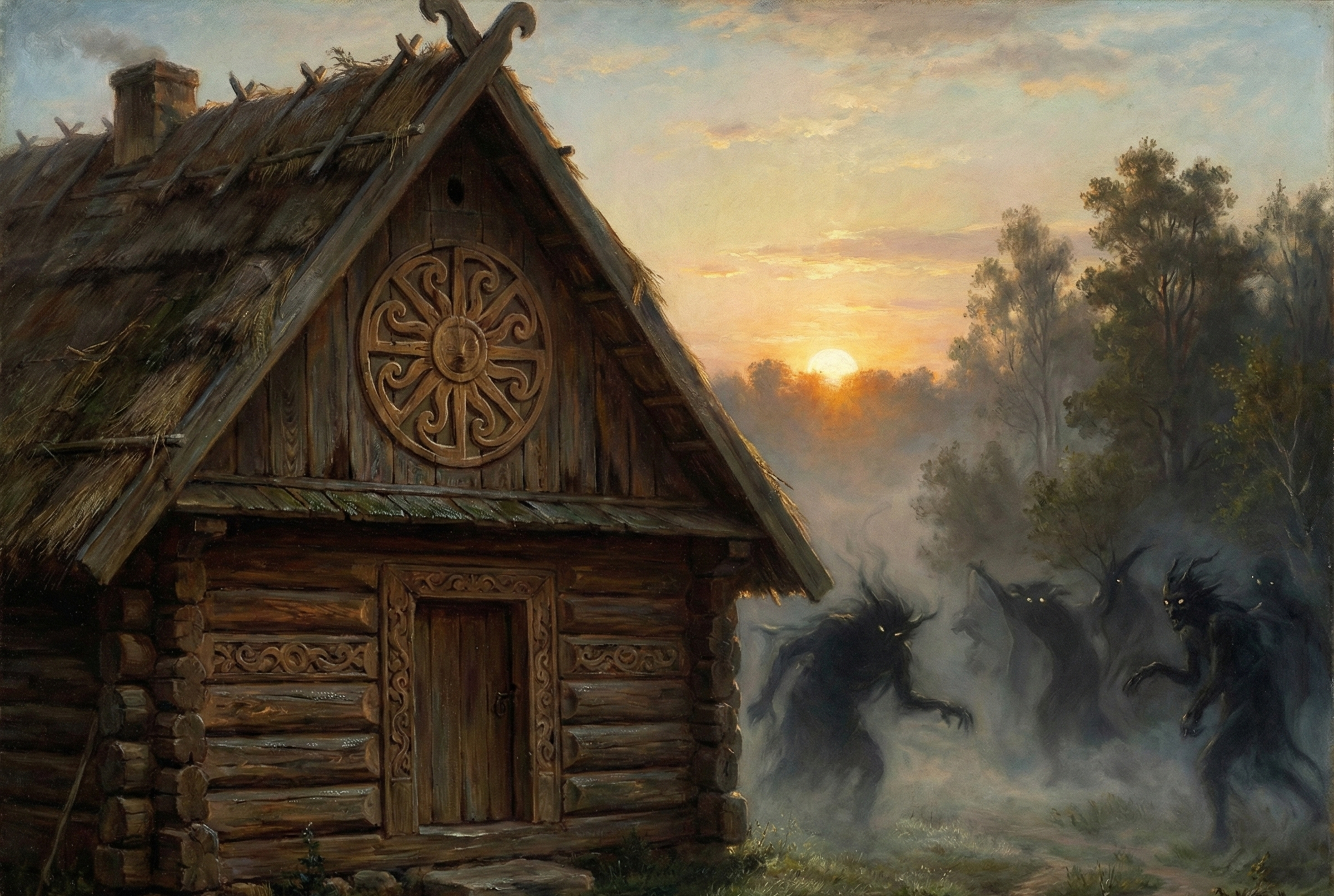
The sun does not simply “rise” and “set” in Slavic cosmology. It undertakes a heroic journey each day, a battle against the forces of darkness that threaten to devour it.
At dawn, the sun emerges from the eastern gates of the world, often depicted as massive doors guarded by spirits or ancestors. It is young, weak, still gathering strength. This is why morning prayers were essential—the sun required human encouragement to begin its ascent. Without these prayers, some believed, the sun might falter, might sink back into the underworld, leaving the world in eternal night.
By midday, the sun reaches its zenith—the point of maximum power, heat, and danger. This is when Perun, the Thunder God, rides closest to the earth, when lightning is most likely to strike, when demons retreat to their deepest hiding places. Noon (południe) was a time of heightened spiritual activity, both protective and dangerous. Farmers avoided working in the fields at noon, fearing the Poludnica (Noon Demon), a female spirit who wandered the grain with a scythe, testing those who dared disturb the sun’s peak moment.
As the sun descends toward the western horizon, it ages. By sunset, the sun is an old, exhausted traveler, sinking into the underworld ocean where it will die. But this death is not final. During the night, the sun travels through Nav—the realm of the dead, the underground world—being cleansed, rejuvenated, and reborn. By dawn, it emerges young again, ready to repeat the cycle.
This daily death and rebirth was the template for all human existence. If the sun could die and return, so could humans. If the sun could traverse the underworld and emerge unscathed, so could the souls of the dead. The Kolovrat, spinning eternally, encoded this promise: nothing ends; everything turns.
[/expand]