February 1, 2026
1 min
[expand]In the 20th and 21st centuries, tattooing returned—secularized, commercialized, stripped of sacred context. But among those exploring Slavic paganism (Rodnovery), there is growing interest in reconstructing ancient tattoo practices.…
February 1, 2026
1 min
[expand]The Church violently opposed tattooing, condemning it as pagan mutilation. Leviticus was cited: “Do not cut your bodies for the dead or put tattoo marks on yourselves.” Tattooed individuals…
February 1, 2026
1 min
[expand]Physical evidence for Slavic tattoos is limited—skin decomposes, leaving no trace. But indirect evidence exists: Preserved Bodies: Bog bodies from northern Europe (Celtic and Germanic tribes) show elaborate tattoos,…
February 1, 2026
1 min
[expand]Tattooing practices likely differed between men and women, though evidence for women’s practices is frustratingly sparse. Men: Male tattoos were more visible, more martial, more public. Warriors displayed their…
February 1, 2026
2 min
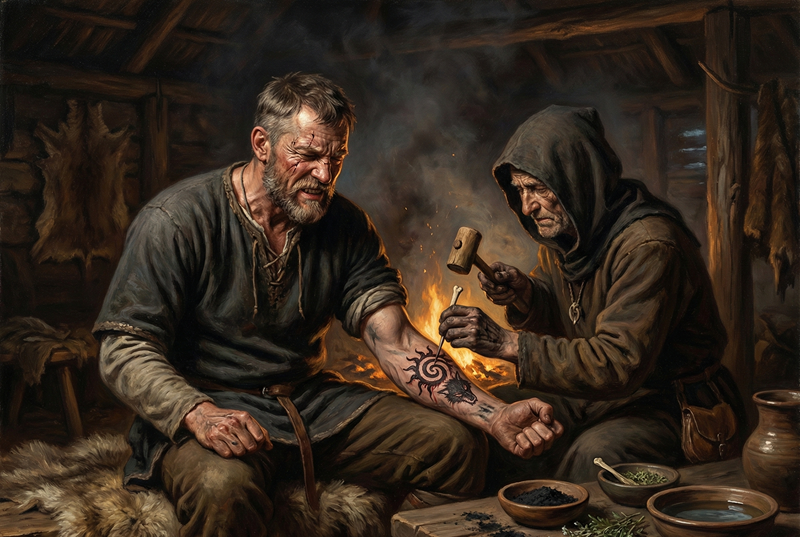
[expand]Tattooing was not a casual procedure. It was a ritual ordeal, painful and dangerous, requiring preparation and spiritual focus. The Artist: Not everyone could tattoo. The artist was usually…
February 1, 2026
2 min
[expand]The symbols chosen for tattoos were not arbitrary. They carried power, obligation, and identity. Solar Symbols: The Kolovrat (spinning wheel, sun in motion) was a common tattoo for those…
February 1, 2026
3 min
[expand]Tattoos were not applied casually. They marked transitions, achievements, and initiations—moments when the individual’s identity fundamentally changed. Coming of Age: When a boy became a man—usually around age 12-15,…
February 1, 2026
1 min
The Permanent Mark [expand]Cloth could be torn. Wood could burn. Stone could crack. But the skin—the living boundary between self and world—was the most intimate and enduring surface for sacred…