[expand]
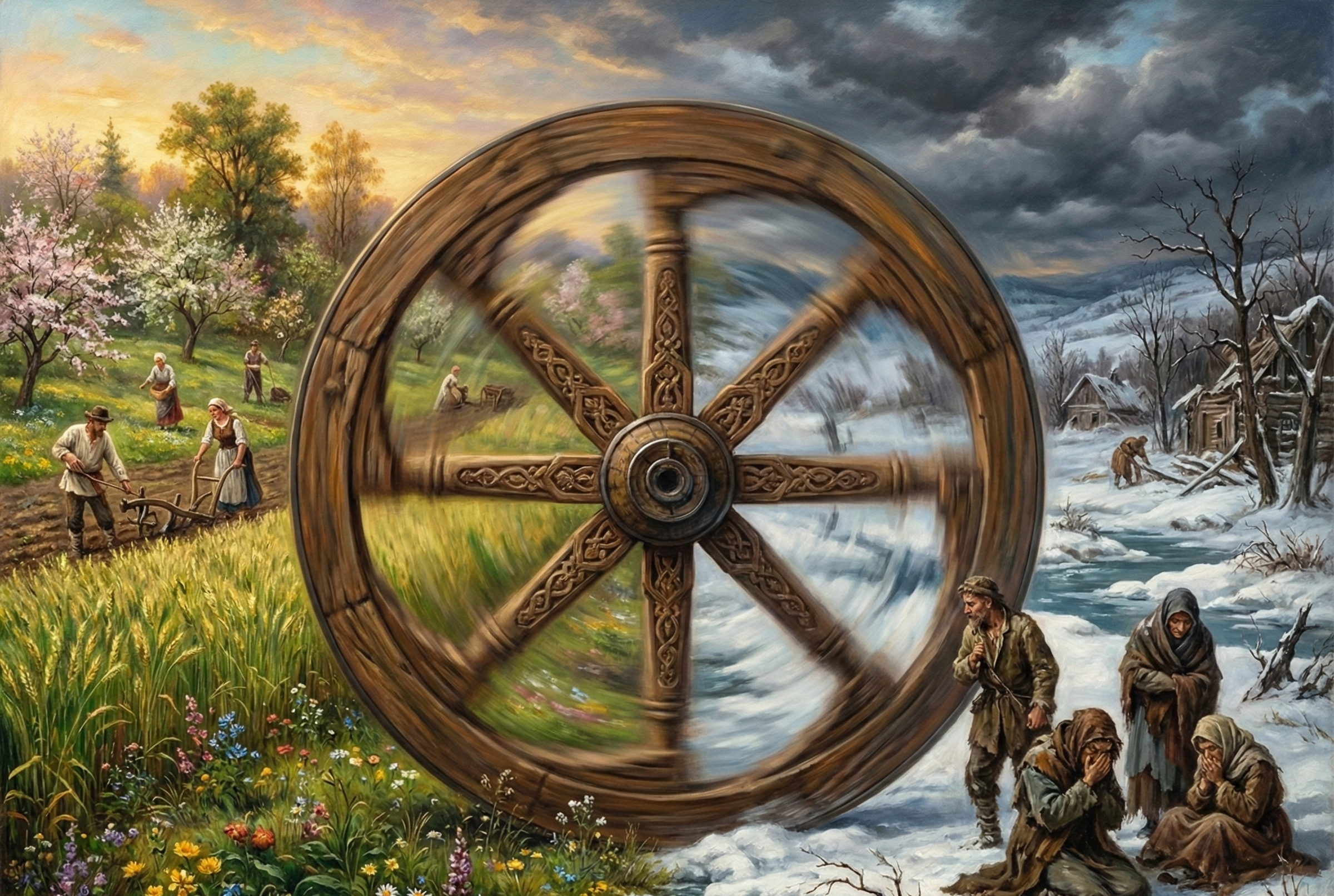
The sun’s motion was not only daily but yearly, and the Kolovrat served as a calendar, a map of the agricultural and ritual year.
The Winter Solstice (around December 21) was the sun’s death—the longest night, the moment when darkness seemed poised to win. But it was also the sun’s rebirth. After the solstice, days grew longer. Light was returning. This was celebrated with fire festivals—bonfires lit to encourage the sun, to remind it of its duty, to assist its resurrection.
The Spring Equinox (around March 21) was the sun’s youth—equal day and equal night, balance restored, the earth awakening. Seeds were planted. Animals gave birth. The world turned green.
The Summer Solstice (around June 21) was the sun’s peak—maximum light, maximum power, the triumph of growth over decay. This was Kupala Night, when fires were lit on hilltops, when young people leaped over flames to purify themselves, when herbs were gathered at their most potent.
The Autumn Equinox (around September 21) was the sun’s decline—harvest time, the beginning of withdrawal, the earth preparing for sleep. Thanks were given. Offerings were made. The last sheaf of grain was left standing in the field as a gift to the spirits.
Between these four cardinal points lay the cross-quarter days—early February, early May, early August, early November—marking the transitions between seasons. Each had its rituals, its taboos, its specific relationship to the sun’s power.
The eight-spoked Kolovrat was a mnemonic device, a visual reminder of this sacred calendar. A farmer could look at the symbol and know where he stood in the year’s great wheel. A priest could use it to calculate when rituals should be performed. A weaver could embroider it into cloth, encoding the entire year’s pattern into fabric.
[/expand]