[expand]
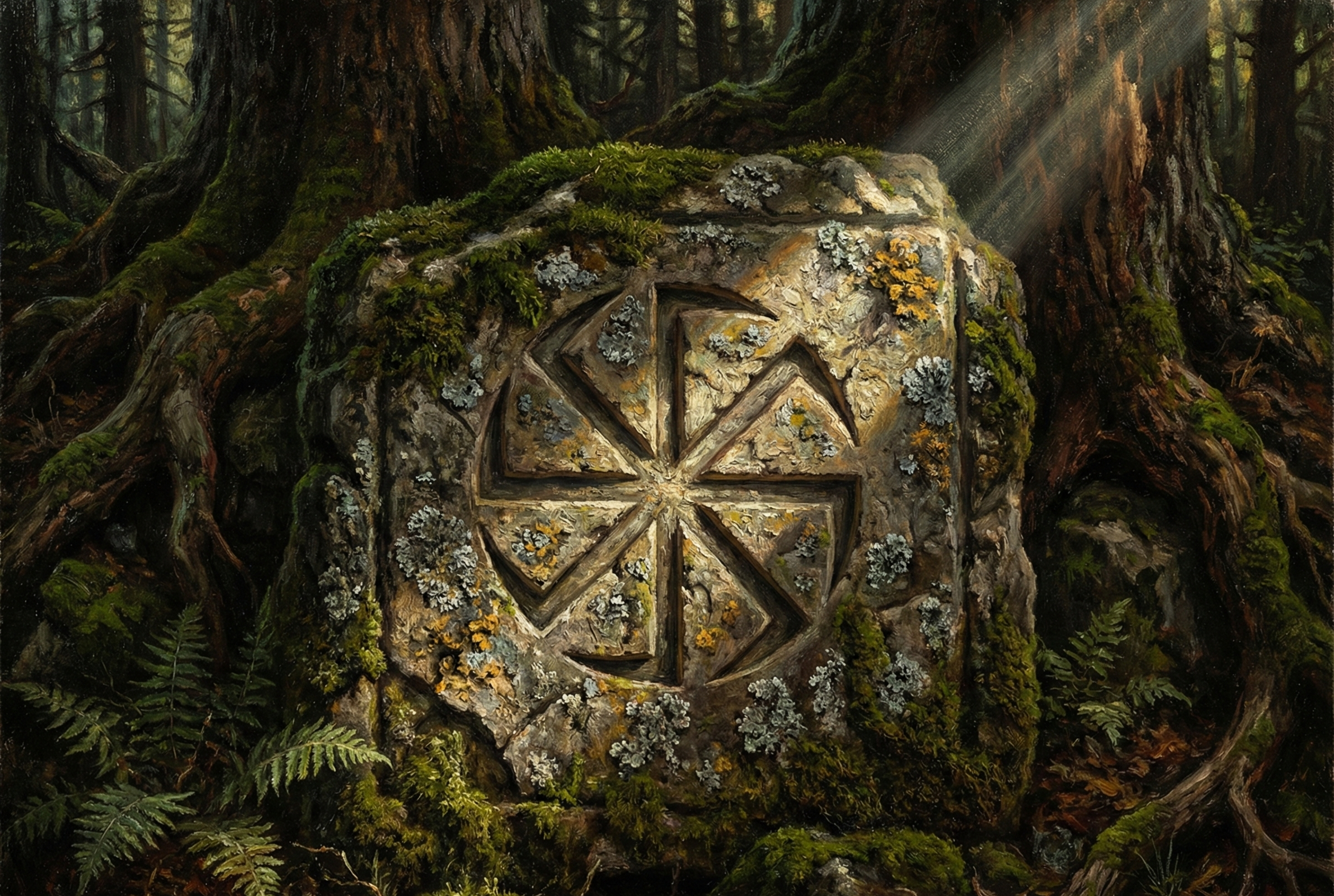
The word kolovrat comes from two roots: kolo (wheel) and vrat (to turn, to spin). It is the Wheel that Turns, the symbol of the sun in motion, the representation of cosmic rotation. The Kolovrat appears throughout Slavic archaeology—carved into wood, embroidered into cloth, etched into stone, painted on pottery. Its form varies, but its essence remains constant: a circle divided by radiating spokes, creating the visual impression of a wheel spinning at tremendous speed.
Most commonly, the Kolovrat has six or eight spokes, though variations exist. The number is not arbitrary. Six spokes represent the six directions—north, south, east, west, up (sky), and down (underworld)—the totality of space. Eight spokes represent the eight seasonal festivals that divide the solar year: the two solstices, the two equinoxes, and the four cross-quarter days between them. The Kolovrat does not depict one moment; it depicts all moments simultaneously, the entire year compressed into a single rotating symbol.
The direction of the spokes matters. A clockwise Kolovrat (spokes turning to the right, following the sun’s apparent motion across the sky) represents growth, life, expansion—summer’s energy. A counterclockwise Kolovrat (spokes turning to the left, against the sun’s motion) represents decline, death, contraction—winter’s withdrawal. Both are necessary. Both are sacred. The Kolovrat reminds that growth without decline is cancer, and decline without growth is extinction. The wheel must turn both ways to maintain balance.
[/expand]