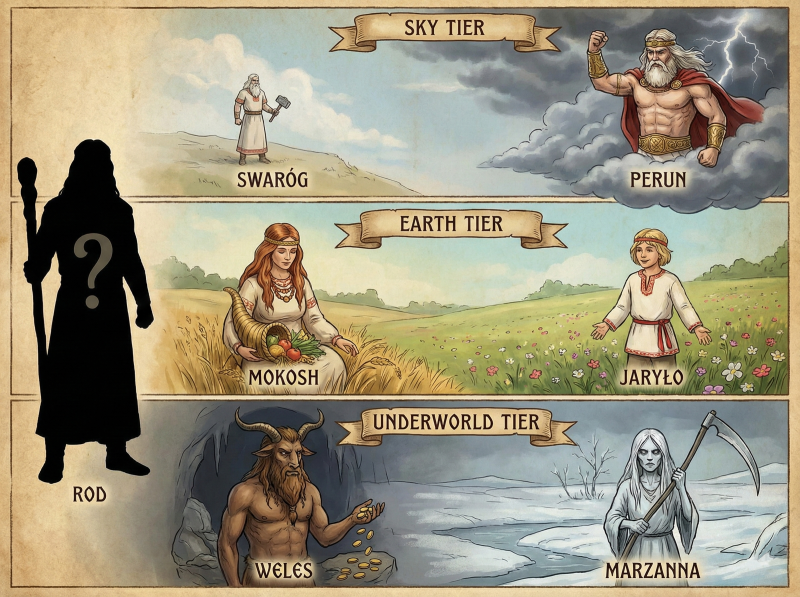
To truly understand the spiritual landscape of the ancient Slavs, one must view their pantheon not merely as a collection of quaint myths, but as a profound system of cultural technology. The gods were not abstract fictions; they were intensely practical frameworks that our ancestors utilized to organize the relentless march of time, to legitimize earthly power, to heal communal trauma, and to make sense of inevitable suffering.
This deep exploration of the Slavic sacred sphere is anchored by seven foundational pillars, each representing a vital face of the infinite:
1. Perun: The Sovereign of the Sky The great Thunderer stands as the supreme god of the sky and the ultimate enforcer of cosmic and earthly law. He is the flash of the lightning bolt, the protector of the warrior class, and the uncompromising judge of human oaths.
2. Weles: The Lord of the Deep The eternal counterpart to Perun, Weles rules the shadowed underworld. He is the master of magic, the patron of poetry, and the guardian of horned cattle and earthly wealth. He governs the deep, untamed mysteries that the rigid laws of the sky cannot control.
3. Mokosh: The Great Mother The weaver of human fate and the embodiment of Mat Syra Zemlya (Mother Moist Earth). She is the deeply venerated protector of women, childbirth, and fertility, and the only goddess to be explicitly named in the highest echelons of the ancient pantheons.
4. Swaróg: The Celestial Architect The distant, primordial Smith who forged the sun and established the mechanical laws of the universe. He is the ultimate creator who brought light to the world before withdrawing to let his descendants rule the active earth.
5. Swarożyc: The Living Flame The earthly manifestation of divine fire. He is the crackling warmth of the domestic hearth and the fierce, protective guardian flame burning within the great wooden temples of the ancient tribes.
6. Jaryło: The Wild Spirit of Spring The virile, untamed god of vegetation and fertility. His eternal, cyclical dance of death and resurrection unlocks the frozen earth each year, perfectly mirroring the violent, beautiful rhythm of the agricultural cycle.
7. Chors & The Lunula: The Lunar Mystery The quiet, powerful domain of the moon. This pillar explores the deep nocturnal mysteries of Chors and the protective, feminine magic symbolized by the Lunula—the silver, crescent-shaped amulets worn to ward off the terrors of the night.
Together, these seven pillars form the spiritual architecture of a people who did not bow to their gods in quiet submission, but rather lived alongside them in a fierce, sacred, and eternal partnership.