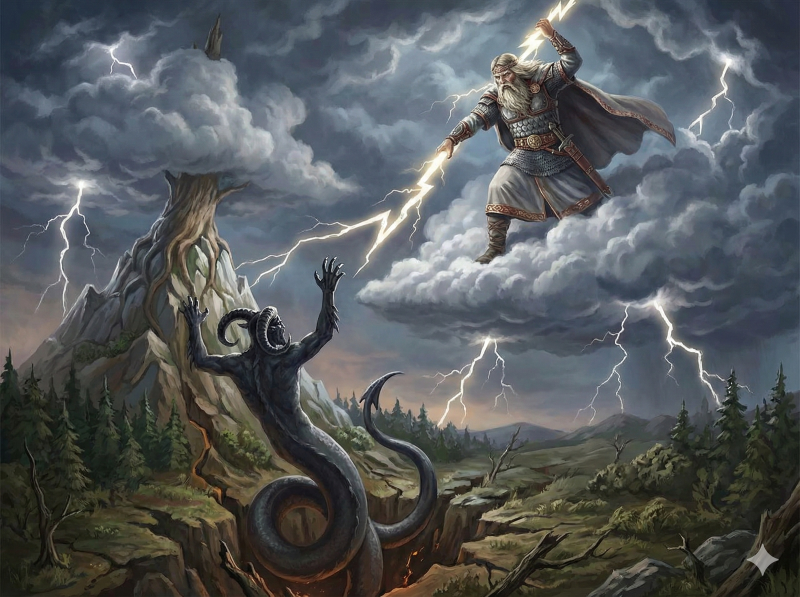
When Christianity swept across Eastern Europe, it did not encounter a scattered collection of primitive superstitions. It found a complete, deeply sophisticated cosmology—one that was internally consistent and empirically tested over millennia of survival. The Slavic gods were not arbitrary fictions born of ignorance; they were precise maps of observable, undeniable forces. The thunder truly is powerful and absolute. The earth truly does give life. The moon truly does control the tides and the hidden cycles of nature.
Because this indigenous worldview was so deeply rooted in the physical and psychological reality of the people, the new Church quickly realized it could not simply destroy it. Instead, it was forced to absorb it.
The Great Absorption
The ancient deities did not vanish; they donned new masks. Perun, the great Thunderer, was seamlessly transformed into Saint Elijah—both of whom were revered for riding across the sky in roaring chariots and commanding the furious storms. Mokosh, the Great Mother who wove the threads of fate, was carefully veiled as Saint Paraskeva, maintaining her sacred association with Fridays and her fierce protection of women.
The fate of Weles, the Lord of the Underworld, was perhaps the most complex. His vast domain was shattered and divided by the new theology. His benevolent, wealth-giving aspects were absorbed by Saint Nicholas, who became the protector of merchants and travelers. Meanwhile, his dark, shape-shifting mastery over the deep woods and the underworld was demonized, casting him into the role of the Christian Devil.
The Gods Are Still Being Fed
Though the great wooden idols were cast into the rivers and the sacred oak groves were cut down to build churches, the ancient bones of the culture remained unbroken. The old faith simply retreated from the temples and took quiet refuge in the hearth, the fields, and the deepest corners of the mind.
Even today, the echoes of this cosmic drama are everywhere. When a Polish grandmother ties a red thread around a newborn’s wrist to ward off the evil eye, she is practicing the old magic. When a Russian farmer silently pours a splash of vodka onto the dark soil before the autumn harvest, he is making a ritual offering. When a Ukrainian girl weaves wildflowers and floats her burning wreath down the river on Kupala Night, she is participating in a sacred rite that predates written history. Through these quiet, everyday acts of reverence, the ancient gods are still being fed.
To study Slavic spirituality is not to look back at a dead religion, but to learn how to recognize its pulse in the present. You can see it in the enduring folktales, in the carved wooden architecture of rural villages, in the relentless turning of the seasons, and—if you carry the heritage—in your very own bones. The old gods of the forest and sky are not dead. They are only sleeping, and there are still those who remember exactly how to wake them.