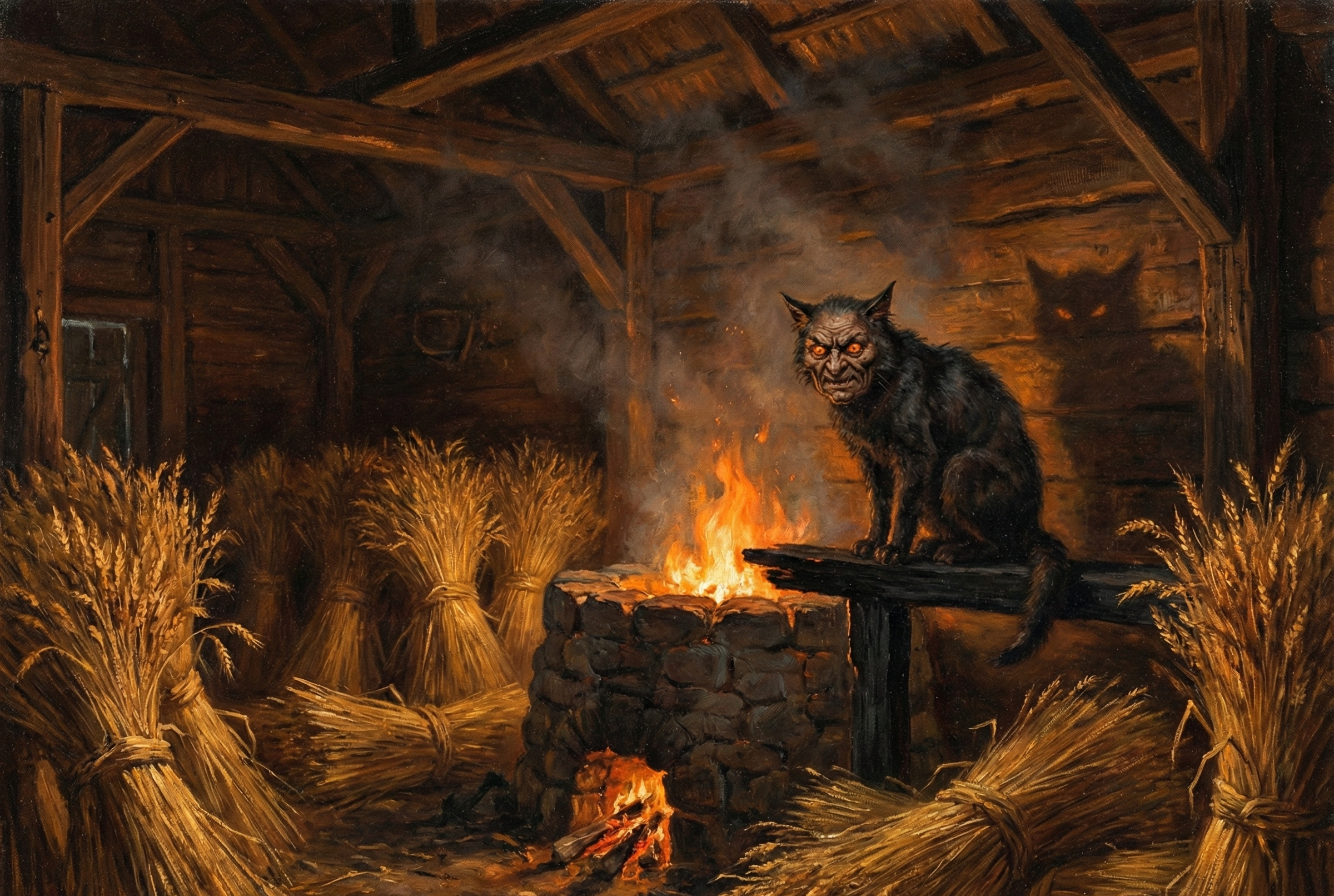
In the daily struggle of ancient Slavic agricultural life, every building on the farmstead housed a spirit. While the Domovoy protected the warmth of the family hearth and the Dvorovoy watched over the stable, the darkest corners of the property were claimed by a far more volatile entity. This was the Ovinnik—the guardian of the threshing floor. Second only to the Noon Wraith (Poludnica) in his sheer, unbridled malice, the Ovinnik was not a protector. He was a terrifying arbiter of life, death, and fire.
The Volatile Kingdom of the Ovín
The demon’s name derives directly from his domain: the ovín. This was the specialized grain-drying shed and threshing floor, a structure as absolutely critical to winter survival as the house itself. Yet, by its very nature, the ovín was a ticking time bomb. Inside, freshly harvested grain was dried on racks suspended directly over open fires. The air was perpetually thick with highly combustible grain dust. Because it was essentially a powder keg, the ovín was built on the edge of the property, far from the main house and often near the bathhouse. It was a liminal space—immensely productive, yet inherently dangerous.
The Ovinnik was the living embodiment of this volatility.
The Black Form and the Crackling Voice
While the house spirit might appear gray and furry, the Ovinnik was defined by absolute darkness. He was covered in soot, or perhaps forged entirely from shadows. When he chose to make himself visible, he appeared as a small, old man, his body charred and blackened as if he had been repeatedly burned in a furnace. His eyes glowed in the darkness like hot coals. At other times, he manifested as a massive black cat with eyes that reflected firelight, or simply as a shifting mass of pure shadow devoid of features.
His voice carried the terrifying reality of his nature. When he spoke, it was a harsh, crackling sound, like dry wood splitting in the heat. When he laughed, it echoed through the shed like the roar of flames suddenly consuming dry straw.
Hostility and the Price of Silence
The Ovinnik was actively hostile toward humans. He harbored a deep, smoldering resentment, believing that the humans were constantly stealing “his” grain, intruding on “his” space, and manipulating “his” fire. Consequently, working in the ovín required extreme caution and constant pacification.
Silence was the first rule of survival. While inside the shed, humans were forbidden from singing, shouting, or laughing loudly. The work of drying and threshing had to be conducted in near-silence, as unnecessary noise enraged the shadow in the corners.
To maintain a fragile truce, annual sacrifices were mandatory, usually at the beginning of the harvest season. A rooster would be slaughtered, its blood poured beneath the foundations or its body left inside the darkness for the Ovinnik to consume. Furthermore, a special loaf of bread—strictly forbidden for human consumption—would be baked and left on the drying racks overnight. By morning, the bread remained physically intact, but the ancient Slavs knew the spirit had consumed its vital essence.
The Oracle at the Threshold
Despite his terrible temper, the Ovinnik possessed profound prophetic power, making the ovín a site of terrifying winter divination. On the dark, freezing nights of the winter solstice or New Year’s Eve, a young, unmarried villager might approach the shed completely alone at midnight.
Standing outside, they would extend a bare hand blindly through the threshold into the pitch-black interior, and wait. Eventually, the Ovinnik would reach out and touch them. If the hand felt a soft, warm, furry touch, it was a prophecy of good fortune, a successful harvest, and a prosperous year. But if the touch was cold, rough, and scaly, it was a doom-laden omen of crop failure, misery, or death. Crucially, the seeker had to remain perfectly calm; to scream or pull the hand away in fear was to insult the demon and invite immediate punishment.
The Wrath of the Burning Shed
The ultimate threat of the Ovinnik was his absolute command over fire. If his rules were broken, or if the sacrifices were deemed insufficient, he would destroy his own kingdom simply to punish the humans.
Sometimes, he offered a fleeting warning. Workers might hear a dry, gleeful, crackling laughter emanating from an empty corner, or suddenly smell thick smoke when no fire was lit. The message was clear: flee immediately, for nothing could stop what was coming.
When the Ovinnik set the ovín ablaze, the conflagration was unnatural. The fire spread with terrifying, explosive speed. Throwing water on the flames only seemed to make them grow fiercer, and the entire structure would be consumed in a matter of minutes. Worse still, his rage did not discriminate, and the cursed fire could easily spread to the barn or the family home. After such a disaster, the blackened earth where the shed once stood was considered forever cursed. The Ovinnik’s anger had poisoned the soil, forcing the devastated family to abandon the site and build their new threshing floor elsewhere, always hoping to appease the new shadow that would inevitably take up residence in the dark.