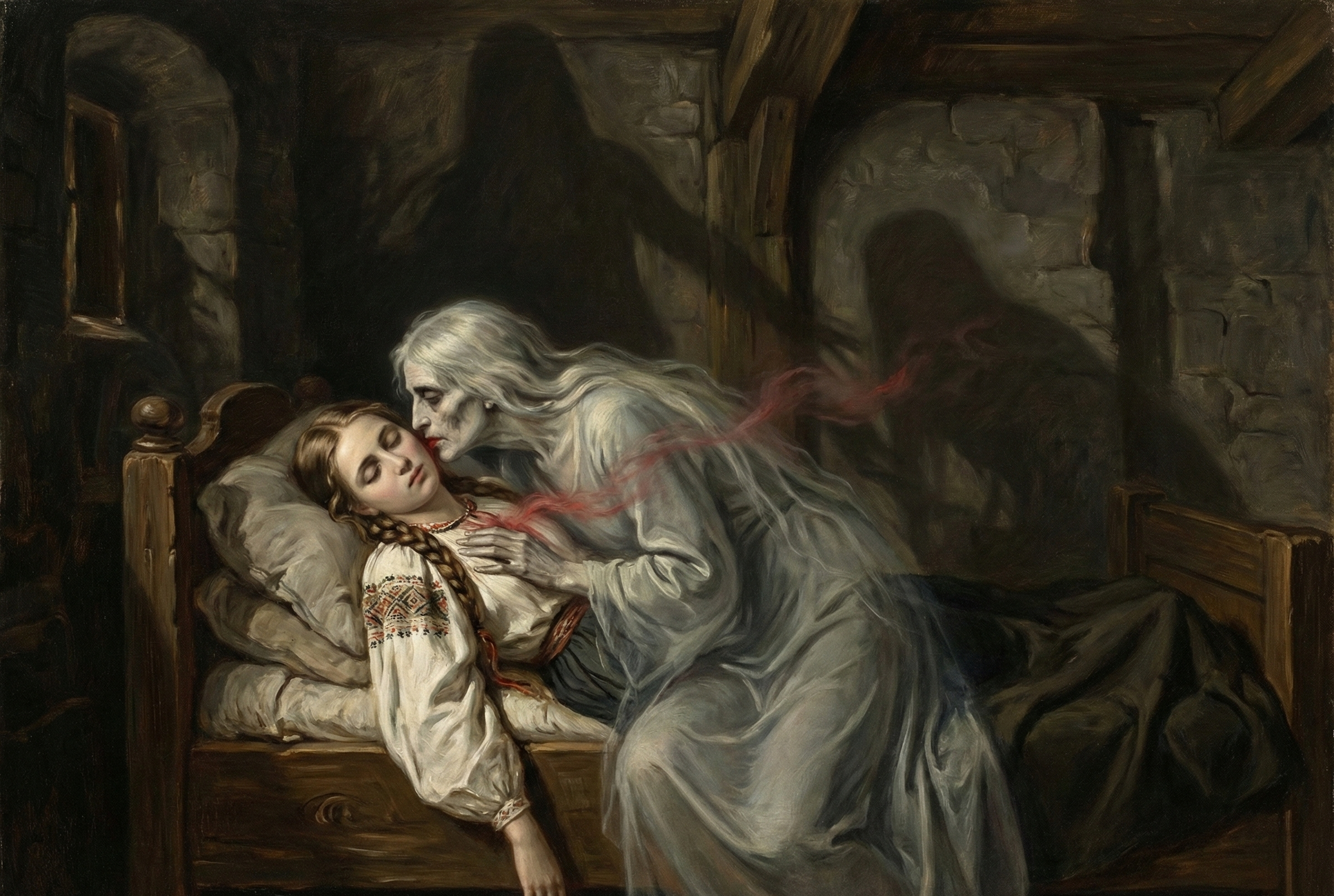
In the dark catalog of Slavic demonology, the Zmora holds a uniquely tragic and terrifying position. She is an absolute anomaly because she is not a ghost, a corpse, or a creature born of the unquiet dead. She is a living person. Specifically, the Zmora is the wandering soul of a living woman—a soul that slips out of her body during deep sleep to attack, suffocate, and strangle others.
Linguistically, her name is an intensified, concretized form of the word mora (nightmare or death-specter). While a mara is ethereal, visual, and fleeting, the addition of the prefix z- grounds the demon in physical reality. The Zmora has weight, pressure, and tactile substance. She is simultaneously victim and perpetrator, entirely human by day and monstrous by night.
The Markers of the Wandering Soul
The host of a Zmora is almost overwhelmingly female in folklore, though male equivalents occasionally exist. She is not a willing practitioner of dark magic, but rather a woman afflicted with a profound spiritual abnormality.
Villagers watched closely for the physical markers that identified a potential Zmora. The most prominent was a monobrow (zrośnięte brwi), where thick eyebrows met above the nose in a continuous line. Heterochromia—possessing two differently colored eyes—was another strong indicator. Being born as the seventh daughter in a continuous line, or being born with a caul (the amniotic membrane covering the face), marked a child for this dark destiny. As she grew older, the woman would develop a perpetually pale, exhausted complexion. This was the biological toll of her affliction: while her physical body rested in bed, her soul worked furiously through the night, leaving her drained of vitality.
The mechanism of her attack was intensely strange. During deep sleep, the woman’s soul would exit her body through her mouth. It rarely traveled in human form. Instead, it would manifest as a small animal—a mouse, a moth, a butterfly, or a beetle. Sometimes it appeared as a wisp of smoke, and occasionally, as absurd as it sounds, as a simple piece of straw or a single blade of grass.
The greatest tragedy of the Zmora is her absolute unawareness. The woman herself usually had no idea what she was. She retained no memory of the nightly attacks, waking each morning exhausted and plagued by vague nightmares, completely ignorant of the fact that her soul had spent the night crushing the life out of her neighbors.
The Straw Trap and the Morning Revelation
When a Zmora attacked, the victim would wake in the paralyzing grip of terror, feeling an immense, crushing weight on their chest—a profound cultural explanation for what modern medicine calls sleep paralysis. But because the Zmora possessed physical substance in her altered state, she could be fought. She could be trapped.
The ritual of capture required immense courage. While enduring the suffocating pressure, the victim had to remain perfectly calm, slowly reach up into the darkness, and grab whatever was pressing down upon them. Usually, their fingers would close around something small and light—a tuft of hair or a piece of straw. The victim had to hold onto this object with a death grip, fighting through the entity’s desperate thrashing and pulling, and refuse to let go until dawn.
When the sun rose, the magical constraints of the night were broken. The Zmora’s soul was forced to return to its host body. If a piece of it remained trapped in the victim’s hand, the woman would wake incomplete. In the morning, the victim would deliberately burn or cut the captured straw or hair. Immediately, a local woman would appear in the village bearing a corresponding injury—a sudden burn mark on her hand or a fresh cut on her arm. The demon was publicly unmasked. Once identified, the woman was usually exiled or forced to undergo harsh purification rituals to exorcise the wandering aspect of her soul.
Scythes, Mirrors, and the Coma Trap
To survive the night without enduring the terrifying struggle of the straw trap, the Slavs developed highly specific defenses against the Strangler.
Iron was a primary deterrent. Placing an iron scythe (kosa) under the bed with the sharp blade pointing upward created a protective barrier. Sometimes, a desperate victim would sleep with the scythe resting directly on their chest; the Zmora, attempting to sit upon them, would impale herself or retreat in fear. Spatial inversion was also effective. Sleeping with legs crossed, or completely reversing one’s position in bed so the head rested where the feet usually go, profoundly confused the demon’s orientation, preventing her from finding the victim’s chest. Mirrors placed on the bedroom door facing outward were believed to trap or mesmerize the soul, horrifying the Zmora with her own reflection.
Perhaps the most ingenious defense was the bottle trap. If the Zmora was known to enter the room as a moth or an insect, a defender would place an open glass bottle baited with honey or jam near the bed. Attracted by the sweet scent, the soul-form would crawl inside to feed. The defender would then slam a cork into the bottle, trapping the soul.
The consequences of this trap were immediate and dramatic. Somewhere in the village, the Zmora-woman’s body would instantly fall into a deep, unshakeable coma, unable to wake until the bottle was uncorked and her soul finally released. This method was often used deliberately by suspicious villagers to definitively identify which of their neighbors was carrying the dark, exhausting burden of the Strangler.