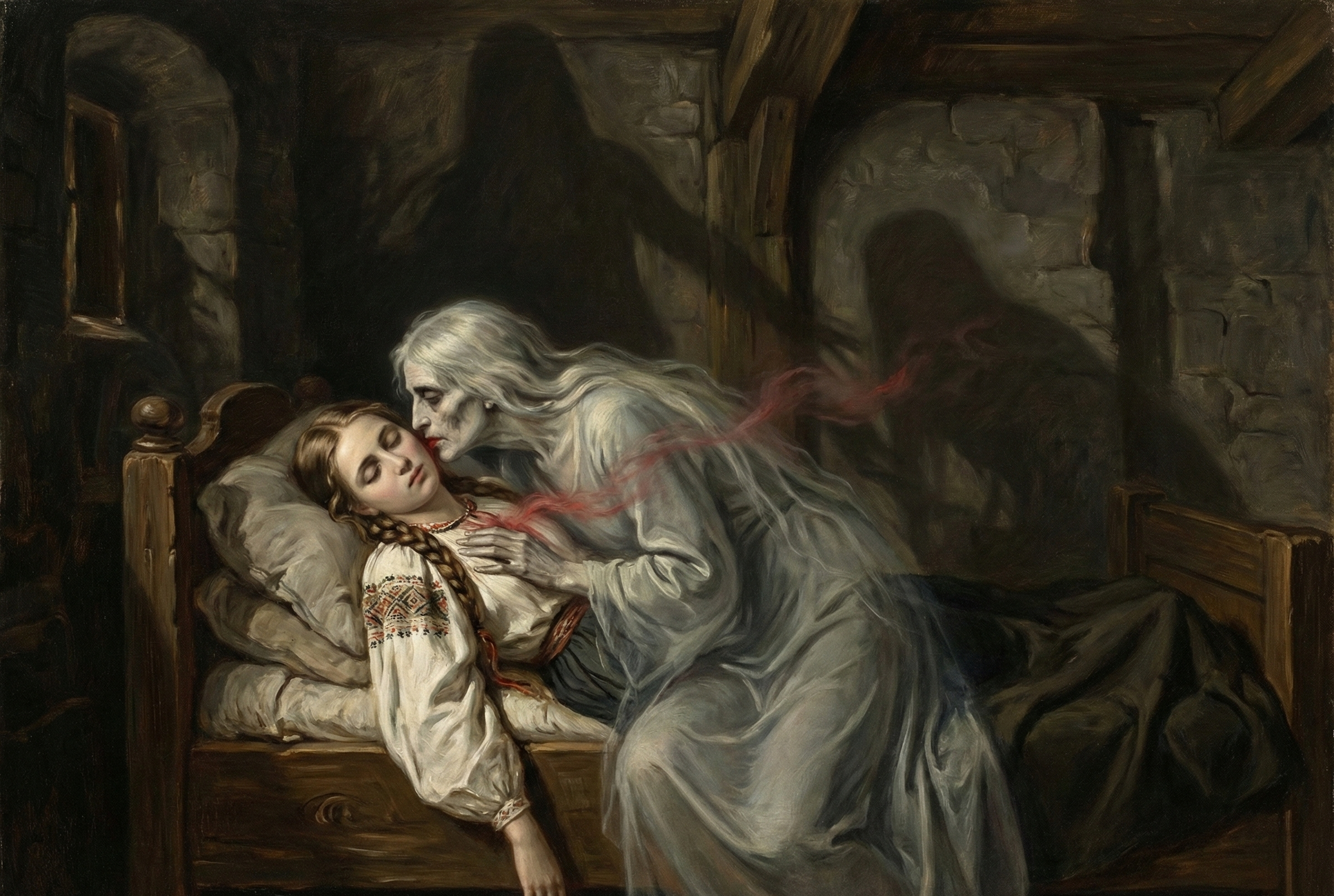
The Night Rider, The Living Soul, The Breath Thief
[expand]
The zmora is unique among Slavic demons because she is not dead. She is a living person—specifically, a living person’s soul that leaves the body during sleep and attacks others. She is simultaneously victim and perpetrator, unaware and guilty, human and monstrous.
The name zmora is an intensified form of mora (nightmare/death-specter), with the prefix z- acting as a concretizer. Where mara is ethereal and visual, zmora is physical and tactile. She has weight, pressure, substance.
[/expand]
The Ontology: The Wandering Soul
[expand]
The Host
The zmora is not a separate entity. She is the soul of a living woman (occasionally a man, but overwhelmingly female in folklore) who possesses a specific spiritual abnormality.
The Markers
Women who become zmory are identified by physical traits:
Monobrow (zrośnięte brwi) – thick eyebrows that meet above the nose, forming one continuous line.
Heterochromia – two different colored eyes (one blue, one brown; one green, one gray).
Being the seventh daughter – or seventh child, with no sons in between.
Born with a caul (czepiec) – the membrane covering the face at birth.
Pale complexion – resulting from the soul’s nightly exertions; the body rests while the soul works, leaving the woman perpetually exhausted.
The Mechanism
During deep sleep, the zmora’s soul exits her body through the mouth. The exit form varies:
A small animal: mouse, moth, butterfly, beetle.
A wisp of smoke or mist.
A piece of straw or a blade of grass (this seems absurd, but it recurs in multiple accounts).
The body remains in bed, breathing shallowly, appearing to sleep normally. But the soul is gone, traveling through the night to attack victims.
The Unawareness
The zmora-woman herself usually does not know what she is. She has no memory of the attacks. She wakes in the morning exhausted, with vague nightmares, but no conscious understanding that her soul has been strangling neighbors.
This creates a tragic duality: the woman is innocent during the day, monstrous at night, and powerless to stop it.
[/expand]
The Modus Operandi: Sleep Paralysis
[expand]
The zmora’s attack creates the phenomenon we now call sleep paralysis—waking but unable to move, with a sensation of crushing weight on the chest.
The Approach
The zmora enters the house through the keyhole (dziurka od klucza) or through cracks in the window. Her soul-form is small, ephemeral, able to slip through any gap.
Once inside, she navigates to the bedroom and sits on the victim’s chest.
The Sensation
The victim wakes—or half-wakes—but cannot move. The body is paralyzed. The eyes may open, but the limbs refuse to respond.
On the chest, there is crushing weight—described as feeling like a heavy stone, or a bony knee, or a huge cat sitting on the ribcage.
Breathing becomes difficult or impossible. The victim gasps, tries to inhale, but the pressure prevents the lungs from expanding fully.
Terror floods the system. The victim wants to scream but cannot. The throat is locked. The voice will not come.
The Feeding
The zmora sucks the breath (dech) out of the victim—not air, but the vital essence carried in breath, the life force.
In some regional variants, the zmora pierces the skin on the chest or tongue to drink blood directly.
In others, she forces her own tongue into the victim’s mouth, a violation both physical and spiritual.
The Release
After minutes (though it feels like hours), the zmora departs. The paralysis lifts. The victim gasps, coughs, can move again.
By morning, there is often a bruise on the chest—red, circular, like a handprint or a mouth-mark.
[/expand]
The Horse Torment
[expand]
The zmora does not limit her attacks to humans. She is equally notorious for tormenting horses.
The Night Ride
The zmora enters the stable, climbs onto the best horse (she always chooses the finest, strongest animal), and rides it through the night—inside the stall, galloping in circles, driving the animal to exhaustion.
The Evidence
By morning, the horse is:
Drenched in sweat (piana) – lather covering its flanks and neck.
Trembling, eyes wide with terror.
Exhausted, barely able to stand.
The Braided Mane
The most distinctive sign: the zmora braids the horse’s mane into tight, intricate knots—the kołtun (Polish plait).
These braids are impossible to untangle by normal means. They are supernaturally tight, the hair woven in patterns that should not be possible.
Critical taboo: You must NEVER cut the kołtun with a knife or scissors. Cutting it will:
- Kill the horse immediately, or
- Summon the zmora to the human house (she will attack the person who cut the braid)
The kołtun must be left to unravel naturally, which can take weeks or months.
[/expand]
The Capture: The Straw Trap
[expand]
Because the zmora has a physical form (even if small and ephemeral), she can be trapped.
The Ritual
During an attack, when the victim feels the crushing weight on their chest, they must:
- Remain calm (extremely difficult under the circumstances).
- Reach up slowly with one hand toward the sensation of pressure.
- Grab whatever is there—it will feel like a piece of straw, a tuft of hair, or something similarly small and light.
- Hold it tightly and do not let go, no matter what happens.
The Struggle
The zmora, trapped, will struggle. The victim may feel intense resistance, pulling, thrashing. But they must hold on until dawn.
When the sun rises, the zmora’s soul must return to its body. If part of it is trapped, the woman will wake incomplete, injured.
The Revelation
In the morning, if the victim burns or cuts the captured object (the straw, the hair), a local woman will appear with a corresponding injury—a burn mark on her hand, a cut on her arm, appearing in the exact place where the object was damaged.
This identifies the zmora-woman publicly. The community now knows who has been attacking them.
The Aftermath
Once identified, the woman is usually exiled or forced to undergo purification rituals. In harsher times, she might be killed—not as punishment, but as exorcism.
[/expand]
The Defenses
[expand]
The Scythe
Placing an iron scythe (kosa) under the bed, blade pointing upward, creates a barrier. The zmora fears being cut by the sharp iron as she descends toward the sleeper.
Alternatively, the scythe can be placed on the chest itself while sleeping—the victim positions the blade carefully so it points upward. The zmora, attempting to sit on the chest, impales herself or retreats.
Inversion
Sleeping with legs crossed or head where the feet normally go (reversed position in bed) confuses the zmora’s orientation. She cannot find the victim’s face or chest to attack.
The Mirror
A mirror placed on the bedroom door, facing outward, traps the zmora’s soul. When she sees her own reflection, she becomes confused, mesmerized, or horrified (depending on the account) and cannot proceed.
The Bottle Trap
If the zmora enters the room in the form of an insect or small animal, a clever defender can:
- Place a bottle with food (honey, jam) near the bed.
- The zmora’s soul-form, attracted to the food, enters the bottle to eat.
- Cork the bottle quickly, trapping the soul inside.
While the soul is trapped, the zmora-woman’s body falls into a coma. She will not wake until the bottle is uncorked and her soul released.
This was sometimes done deliberately to identify zmory—if a woman in the village fell into a sudden, unexplained coma after a zmora attack stopped, the connection was clear
[/expand]