4. Pantheon Structure: Hierarchy or Democracy?
The Question: Is there a “king of gods” (like Zeus/Odin/Jupiter)?
The Answer: COMPLICATED.
Official Hierarchy (Vladimir’s Pantheon 980 AD):
- PERUN (listed first, most expensive materials—DOMINANT!)
2-5. KHORS, DADŹBÓG, STRZYBÓG, SIMARGL (solar/atmospheric group)
6. MOKOSH (earth/fertility—separate category, female exception)
This suggests: Perun = primus inter pares (“first among equals”—leader, but not absolute monarch).
Functional Hierarchy (By Domain):
SKY TIER (High Status):
- SWARÓG (Creator, distant, rarely intervenes—”retired” god?)
- PERUN (Active ruler, thunder/law/war—daily involvement!)
- DADŹBÓG (Sun, life-giver—essential but subordinate to Perun)
EARTH TIER (Immediate Relevance):
- MOKOSZ (Fertility, weaving, fate—MOST WORSHIPPED by common people!)
- JARYŁO (Spring, agriculture—seasonal but crucial!)
UNDERWORLD TIER (Feared/Respected):
- WELES (Magic, wealth, dead—avoided except when needed!)
- MARZANNA (Winter, death—appeased, not beloved!)
AMBIGUOUS:
- ROD (Progenitor—either SUPREME (predates all) or MINOR (household spirit)—debated!)
The Reality: Context-Dependent Supremacy
Different gods supreme in different contexts:
Warrior swearing oath? → PERUN supreme (god of law/oaths!)
Merchant making deal? → WELES supreme (god of commerce/contracts!)
Woman in childbirth? → MOKOSZ supreme (goddess of fertility/fate!)
Farmer planting crops? → JARYŁO supreme (god of spring/growth!)
No single “king”—instead, situational PRIMACY (whichever god relevant to your need = most important at that moment!).
5. Divine Relationships: The Cosmic Drama
Gods aren’t isolated—they INTERACT:
The Eternal Conflict: Perun vs. Weles
Not “good vs. evil”—structural opposition:
- Perun strikes DOWN (lightning from sky)
- Weles rises UP (attempts to steal/climb)
- Cycle never ends (stalemate = world continues!)
When they fight: Storm (thunder = battle sounds!)
When Perun wins: Rain (waters released, crops watered!)
When balance maintained: Seasons (summer = Perun, winter = Weles!)
The Marriage: Perun & Mokosz
Sky Father + Earth Mother = Classic pairing:
- Perun’s rain = semen (inseminates earth!)
- Mokosh’s soil = womb (receives, grows crops!)
- Their union = HARVEST (literal fertility of land!)
But also TENSION:
- Mokosh sometimes helps Weles (earth = underworld connection!)
- Perun jealous? (rains = tears or punishment for infidelity?)
Ambiguity intentional (gods aren’t simple—contradictions exist!).
The Family: Swaróg, Dadźbóg, Swarożyc
Three-generation divine lineage:
Grandfather: SWARÓG (Creator, forges world/sun/laws—then WITHDRAWS!)
Father: DADŹBÓG (Sun, active daily—maintains world Swaróg built!)
Son: SWAROŻYC (Fire on earth, sacrificial flame—humans interact with HIM!)
Pattern = DELEGATION (Creator makes world, Sun maintains it, Fire is accessible to mortals—descending involvement!).
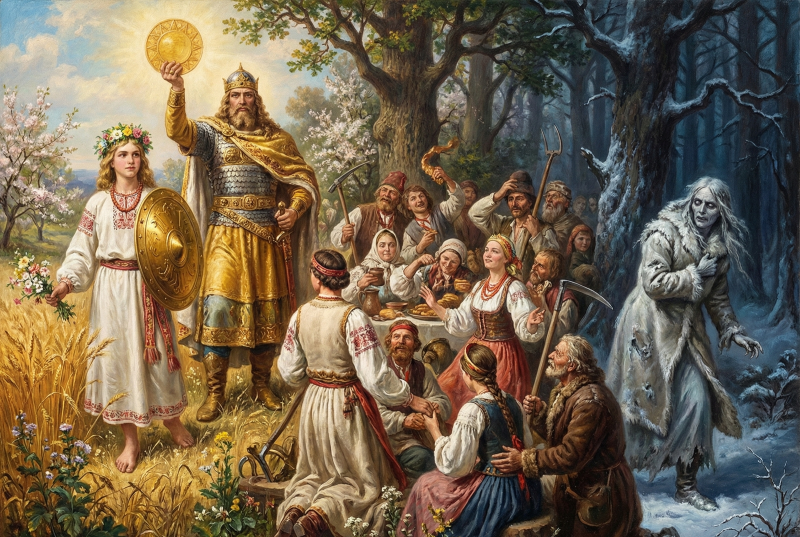
The Cycle: Jaryło & Marzanna
Seasonal couple (tragic romance!):
Spring: Jaryło returns (young, virile, fertile—brings warmth!)
Summer: Marriage (Jaryło + Marzanna = harvest union!)
Autumn: Jaryło dies/ages (spent his energy, fertility exhausted!)
Winter: Marzanna rules alone (cold, barren, waiting for his return!)
Repeat annually (same story, eternal cycle—NOT linear time!).
6. Modern Reconnection: How to Approach These Gods
For Contemporary Pagans/Researchers:
A. Academic Approach (Historical Study):
Goal: Understand what ancestors believed (accuracy over utility).
Method:
- Read primary sources (chronicles, sagas, archaeological reports)
- Compare scholarly interpretations (Rybakov vs. Ivanov/Toporov debates!)
- Acknowledge gaps (don’t invent where evidence lacking!)
Outcome: Knowledge of historical religion (but not necessarily personal practice).
B. Reconstructionist Approach (Revival Attempt):
Goal: Recreate ancient practice as accurately as possible.
Method:
- Use only documented elements (no modern inventions!)
- When gaps exist, extrapolate from Baltic/Germanic cousins (cautiously!)
- Prioritize authenticity (uncomfortable truths included—animal sacrifice, etc.!)
Outcome: Living tradition closest to ancestral (but inevitably incomplete—sources fragmentary!).
C. Syncretic Approach (Adaptive Practice):
Goal: Connect with Slavic gods in modern context (relevance over purity).
Method:
- Honor core principles (Perun = justice, Mokosz = earth-care, etc.)
- Adapt rituals to modern life (can’t sacrifice bulls? Use symbolic offerings!)
- Mix with other traditions IF respectful (UPG = “Unverified Personal Gnosis” acknowledged as such!)
Outcome: Living spirituality that feeds soul (but historians might critique accuracy!).
D. Symbolic Approach (Psychological Archetypes):
Goal: Use gods as mental models (Jung-influenced, therapeutic).
Method:
- Perun = Inner Warrior (discipline, justice, order)
- Weles = Shadow Self (hidden depths, magic, taboo knowledge)
- Mokosz = Anima/Great Mother (nurturing, fate-weaving, groundedness)
Outcome: Psychological integration (whether gods “literally exist” becomes irrelevant—they’re USEFUL!).
All four approaches valid! Choose based on your needs/interests (or combine!).