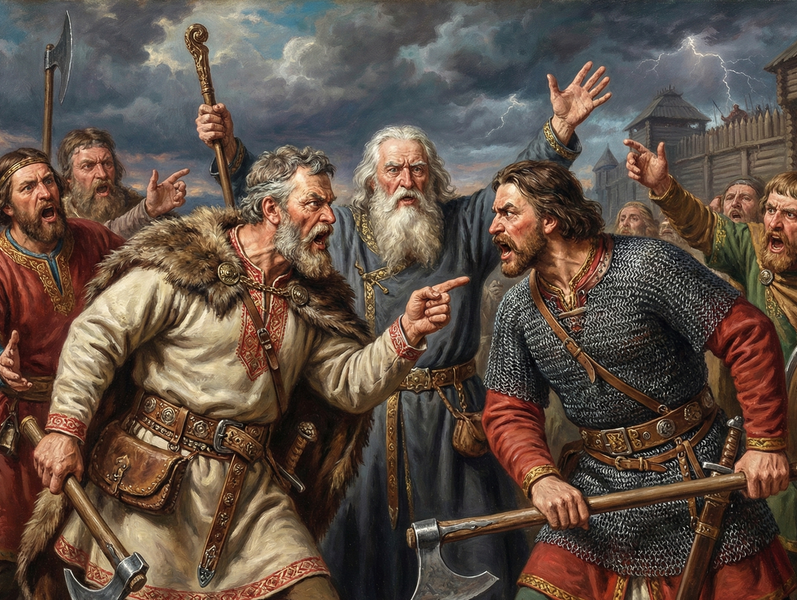
Slavic society was not egalitarian fantasy. It was stratified—layered according to function, proven capacity, and contribution to collective survival. But this stratification was not rigid caste. It was dynamic hierarchy, where excellence could elevate and failure could reduce. Birth mattered, but performance mattered more. A warrior’s son who proved cowardly fell from his father’s status. A farmer’s son who demonstrated exceptional leadership might rise to command.
This fluidity distinguished Slavic hierarchy from feudal systems emerging elsewhere. The Slavs had no hereditary nobility immune to consequences. They had functional elites—those who served essential roles and maintained their position through continued competence. When a leader failed, the tribe replaced him. When a warrior proved unreliable, he was expelled. Status was earned continuously, not inherited permanently.
- The Knyaz (Prince): The War Leader
At the hierarchy’s apex stood the Knyaz—the military and political leader, though not absolute monarch. His power was contractual, based on the tribe’s recognition of his capacity to lead warriors, negotiate with neighbors, and make decisions in crisis.
The Selection:
The Knyaz was typically chosen from a leading family—bloodline mattered as proof of inherited leadership capacity. But confirmation required the Veche’s approval. The assembly could reject an incompetent heir and select a more capable relative, or even invite an outsider if local candidates were insufficient.
The Responsibilities:
- Lead the Druzhina (warrior band) in battle
- Negotiate treaties with other tribes or foreign powers
- Adjudicate major legal disputes (alongside the Veche)
- Organize defense and manage fortifications
- Distribute spoils and administer justice
The Limitations:
The Knyaz was not dictator. He ruled with the Veche, not over it. Major decisions—declaring war, making peace, changing law—required assembly consent. A Knyaz who acted unilaterally risked deposition or assassination.
The Druzhina Contract:
The Knyaz maintained his warrior band through personal loyalty and material reward. Warriors served because they trusted his leadership and received spoils, land, and status. If the Knyaz failed to provide, warriors left to serve more successful leaders.
- The Druzhina: The Warrior Elite
Below the Knyaz stood his Druzhina—professional warriors who formed the military aristocracy.
The Composition:
- Young nobles seeking glory and wealth
- Proven warriors from common families elevated by skill
- Foreign mercenaries (Vikings, steppe nomads) joining for pay
- Younger sons of the Knyaz establishing their own reputations
The Function:
The Druzhina was not merely military. They were:
- The Knyaz’s advisors (forming a war council)
- Administrators of conquered or granted territories
- Enforcement of the Knyaz’s decisions
- The core around which tribal militia rallied
The Economic Basis:
Druzhina members received land grants (estates worked by dependent peasants) or regular payments (portions of tribute, trade profits). Wealthy warriors equipped themselves with expensive weapons (swords, mail) and horses. Poor warriors served with spear and shield, hoping successful campaigns would elevate them.
The Oath:
Warriors swore oaths to the Knyaz—personal loyalty unto death. Breaking this oath meant exile, disgrace, and spiritual curse. Perun, god of oaths and thunder, would strike down the oath-breaker. The oath was not mere formality but sacred contract, binding until death or mutual release.
III. The Veche: The Free Assembly
The Veche represented free adult males—those who owned property, bore arms, and contributed to communal defense. This was direct democracy, loud and sometimes violent, but fundamentally participatory.
The Participants:
- Landowners (farmers with their own plots)
- Craftsmen (blacksmiths, carpenters, potters)
- Merchants (traders, though often foreigners)
- Warriors not part of the Druzhina (militia members)
Women, children, slaves, and landless laborers did not participate—they lacked the economic independence and military capacity that justified political voice.
The Function:
- Approve or reject major decisions (war, peace, leadership changes)
- Judge serious crimes (murder, treason, major theft)
- Manage communal resources (pastures, forests, fisheries)
- Elect or confirm leaders (the Knyaz, elders, judges)
The Process:
Veche meetings were chaotic—men shouting, arguing, sometimes fighting. Decisions required consensus or overwhelming majority. If disagreement was too sharp, the issue was tabled or the community split (one faction leaving to form new settlement).
- The Freemen: The Producing Class
Below the political elite were freemen (lyudi)—the majority of the population, farmers and craftsmen who owned their labor and participated in militia when needed.
The Farmers:
Most Slavs were agriculturalists—growing grain, raising livestock, maintaining households. They were not serfs (bound to land) but free proprietors, though often economically dependent on protection from warrior elites.
The Craftsmen:
Specialized workers—blacksmiths, potters, weavers, carpenters—held higher status than common farmers. Their skills were essential and scarce, granting economic leverage and social respect.
The Obligations:
Freemen owed:
- Labor service (building fortifications, maintaining roads)
- Tribute (grain, livestock, craft products to the Knyaz)
- Military service (joining militia during war)
These obligations were reciprocal—the Knyaz and Druzhina provided protection, justice, and defense. If they failed, freemen withheld support or sought different leadership.
- The Dependent Peasants: The Gray Zone
Between freedom and slavery existed dependent status—peasants who worked land they didn’t own, bound by debt or necessity but not technically enslaved.
The Categories:
- Tenant farmers: Worked estates granted to Druzhina, paid rent in labor/produce
- Debt bondsmen: Borrowed money or grain, worked to repay (interest often made freedom impossible)
- Impoverished freemen: Lost land through misfortune, worked for others while retaining technical freedom
The Dynamics:
Economic pressure constantly pushed freemen toward dependency. Bad harvests, war damage, illness—any misfortune could force a farmer to borrow from wealthier neighbors. Once in debt, escaping was difficult. Over generations, independent farmers became dependent peasants, and dependent peasants became slaves.
- The Slaves: The Unfree
At the hierarchy’s bottom were slaves (kholopy)—those with no legal rights, no property, no political voice.
The Sources:
- War captives: Prisoners taken in battle (the primary source)
- Debt slavery: Those who couldn’t repay debts sold themselves or family members
- Punishment: Criminals (thieves, traitors) enslaved as punishment
- Slave trade: Slaves bought from or sold to foreign merchants
The Functions:
Slaves performed heavy, undesirable labor:
- Agricultural work (especially clearing new land)
- Mining and quarrying
- Domestic service (cooking, cleaning, carrying)
- Occasionally skilled work (if they had crafts before enslavement)
The Status:
Slaves were property—bought, sold, inherited. Owners could beat or kill them with minimal consequence. Sexual exploitation was common. Escape was difficult—branded or mutilated slaves were easily identified.
The Escape:
Freedom was possible through:
- Manumission: Owner granting freedom (rare, usually in wills)
- Purchase: Slave buying freedom (required saving money owner permitted keeping)
- Escape: Fleeing to another territory (risky—recapture meant severe punishment)
VII. The Clergy: Post-Christian Addition
After Christianization, the clergy became a separate hierarchical layer—neither warrior nor farmer, exempt from normal obligations but wielding spiritual authority.
The Integration:
Priests and monks occupied an ambiguous position. They had no military function (theoretically), yet they influenced Veche decisions and advised the Knyaz. They owned land (monasteries became wealthy landowners) but paid no tribute. They claimed authority over marriage, burial, and moral judgment.
This created tension—the clergy asserted power over warriors who saw them as non-contributors. Occasionally, princes stripped monastic lands or expelled troublesome bishops. But generally, the clergy integrated into hierarchy as spiritual specialists, providing services others couldn’t (literacy, intercession with Christian God, record-keeping).
VIII. The Meaning: Functional Stratification
Slavic hierarchy taught:
Function justifies status: Those who contributed received voice and respect. Those who didn’t contribute had neither.
Status is earned: Birth provided advantage, but performance determined retention. Incompetent elites fell; capable commoners rose.
Reciprocity maintains order: Elites provided protection and justice. Commoners provided labor and support. If either side failed, the contract dissolved.
Hierarchy is not oppression: Structured inequality allowed specialization. Not everyone could be warrior or judge. Society needed farmers, craftsmen, and laborers. Each role was honored when performed well.
The Slavic hierarchy was neither egalitarian utopia nor feudal tyranny. It was pragmatic stratification—organizing society to maximize survival, rewarding excellence, and maintaining flexibility. Those who proved their worth rose. Those who failed fell. And the tribe endured, ordered by function, bound by reciprocity, and led by those capable of leading.