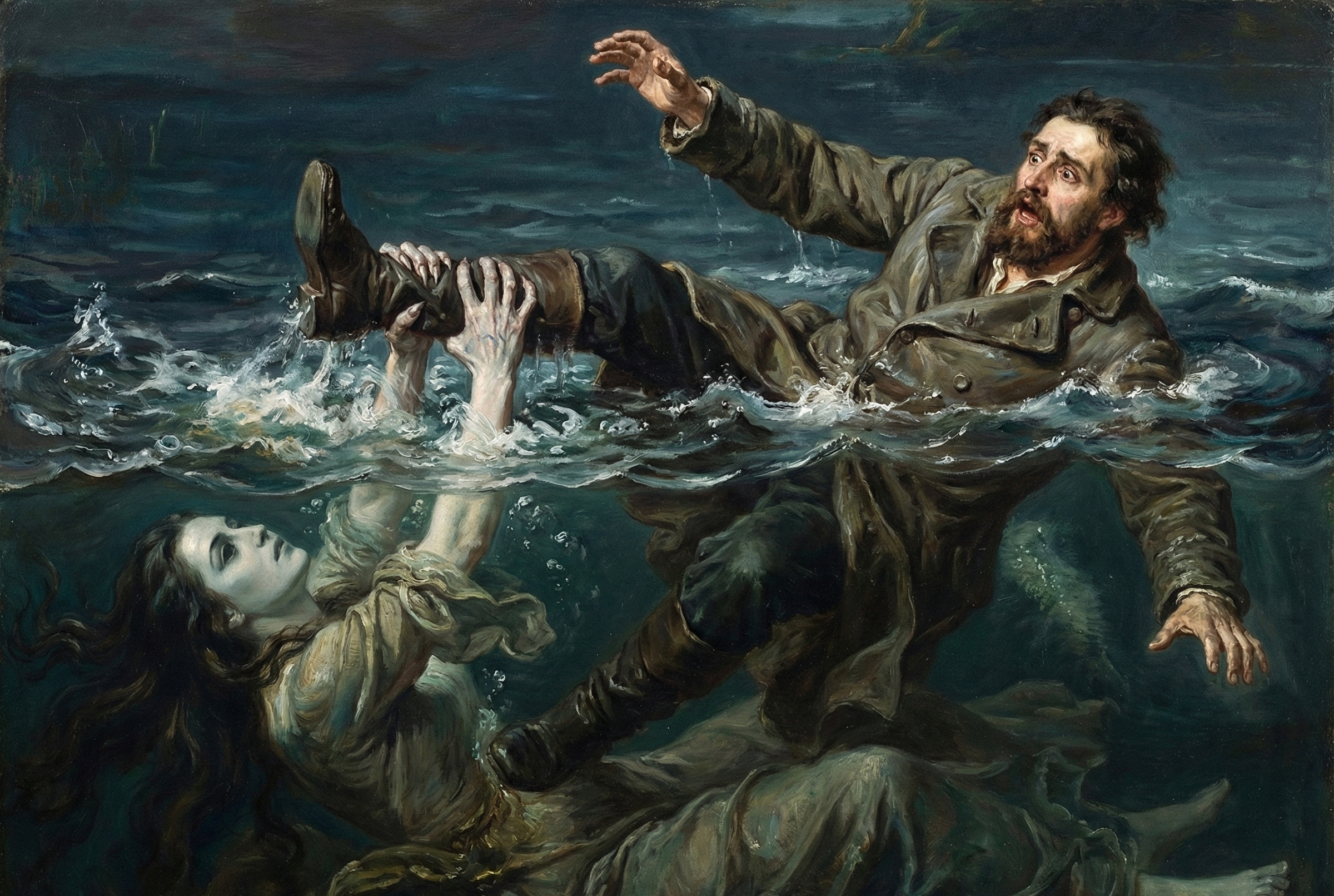
In the dark and highly stratified hierarchy of Slavic water spirits, there is a profound distinction between the masters and the enslaved. While the ancient Vodyanoy rules the deep as a primordial king, and the Rusalka dances on the banks as a semi-divine spirit of fertility, the Topielec occupies the absolute lowest rung. They are not elemental forces of nature. They are merely ghosts—the tragic, enslaved souls of humans who drowned and became trapped in the murky depths, forever barred from reaching the afterlife.
The Etymology of the Drowned
The names given to these tragic figures—topielec for the masculine and topielica for the feminine—are brutally literal. They derive directly from the Slavic verb topić, meaning to drown, to sink, or to melt. To be a topielec is to be entirely defined by the horrific, suffocating final moments of one’s mortal existence.
Trapped in the Boundary Waters
A person was condemned to this watery purgatory if they died in specific, unnatural circumstances. Suicide by drowning was a common cause, particularly among betrayed lovers, desperate pregnant women, or the destitute. Murder victims deliberately held underwater, drunkards who fell off docks, or travelers swept away by spring currents also joined their ranks. In the Christian era, folklore added unbaptized souls to this tragic roster.
The metaphysical trap, however, lay in the element itself. For the ancient Slavs, water was the ultimate boundary element—a threshold separating the world of the living (Yav) from the world of the dead (Navia). When a person died violently within this boundary, their soul became profoundly confused. Unable to find the correct path through the water to the afterlife, the soul became anchored to the exact spot of its death, condemned to linger in the deep as an eternal servant to the Vodyanoy.
The Grotesque Aesthetic of Decay
Unlike the Rusalka, who could appear hauntingly beautiful to lure young men to their doom, the topielec possessed no such glamour. Their appearance was grotesque, reflecting the harsh, biological reality of a drowned corpse.
A topielec appeared bloated, swollen with absorbed water to twice their normal human size, their skin stretched painfully tight. Their flesh was siny—a ghastly blue-black hue characteristic of oxygen deprivation, severe bruising, and advanced decay. They wore the waterlogged, rotting remnants of whatever clothes they died in, hanging in pathetic strips from their bodies. Their hair was a tangled mess of mud and riverweed, framing faces with pale, clouded eyes that stared blankly like those of a dead fish.
Furthermore, their presence was often announced by an unbearable stench. A topielec smelled of stagnant water, rotting vegetation, and decomposing flesh. Because their bodies were so heavy and waterlogged, they did not swim with the predatory grace of other spirits. Instead, they drifted aimlessly on unseen currents or stumbled awkwardly along the muddy riverbed.
The Misery of the Submerged Workforce
The male spirits, the topielce, were largely the infantry and labor force of the river. Enslaved by the Vodyanoy, they spent eternity repairing his underwater palaces, herding his giant catfish, and maintaining the infrastructure of the riverbed. They were tragic and deeply passive entities, existing in a state of perpetual misery and longing for release rather than active malice.
The female spirits, the topielice, were equally tragic and completely distinct from the seductive rusalki. A topielica could be of any age, her beauty entirely erased by decay. A haunting image often associated with the topielica is that of her sitting on the riverbank in the dead of night, endlessly washing her burial shroud or death clothes. She scrubs frantically at stains that will never come out—a potent metaphor for her tragic inability to cleanse herself of her violent death and return to the warmth of life.
The Grip of Loneliness
When a topielec did claim a human life, it was rarely out of hunger or pure demonic malice; it was an act driven by crushing loneliness and bitter envy of the living. Anchored to the exact spot where they perished, they watched the living world continue above them. If an unsuspecting swimmer happened to pass directly over the spot where a topielec was trapped, the ghost would reach up from the dark, cold mud. Driven by the desperate, envious desire for companionship in their eternal misery, the topielec would pull the swimmer down, sharing their tragic fate and adding yet another enslaved soul to the Vodyanoy’s submerged kingdom.