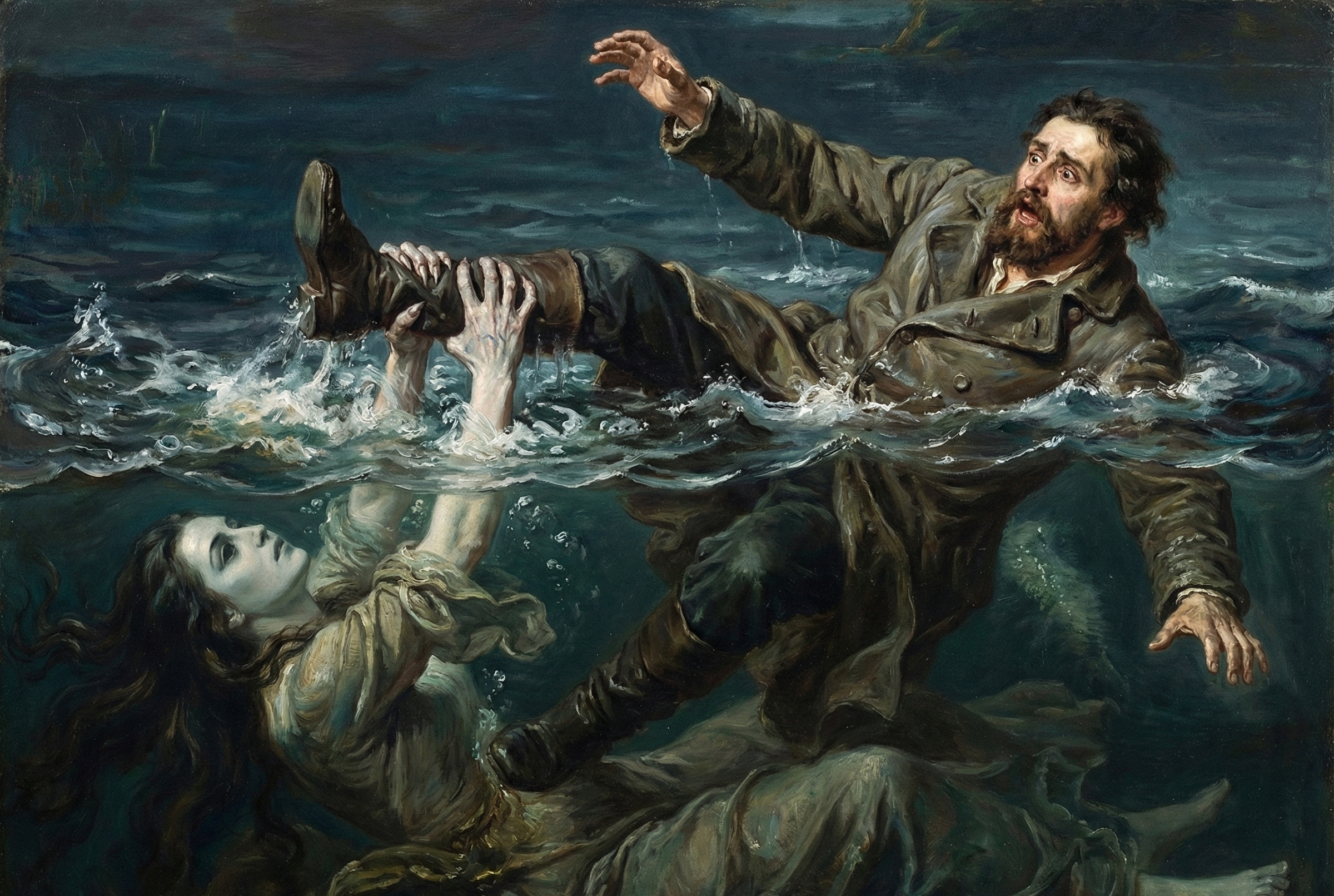
The Infantry of the Vodyanoy, The Tragic Servants
[expand]In the hierarchy of water spirits, the topielec occupies the lowest rank. Where the vodyanoy is king, the topielec is serf. Where the rusalka is a semi-divine fertility spirit, the topielec is simply a ghost—the soul of a person who drowned and became trapped in water, unable to reach the afterlife.[/expand]
The Etymology
[expand]
The word topielec (masculine) and topielica (feminine) derive from the verb topić (to drown / to sink / to melt).
The name is brutally literal: “the drowned one.”
[/expand]
The Ontology: Human Souls Trapped
[expand]
The topielec is fundamentally different from the vodyanoy:
The Vodyanoy: Elemental, never human, primordial water-spirit, master.
The Topielec: Human ghost, drowned victim, enslaved soul, servant.
The Creation
A person becomes a topielec if they drown in specific circumstances:
Suicide by drowning – particularly common among pregnant women, betrayed lovers, or the destitute
Murder – pushed or held underwater deliberately
Accidental drowning – falling through ice, swept away by currents, drunk and falling off a dock
Unbaptized – in Christian-era folklore, anyone who died without baptism was believed to be vulnerable to becoming a topielec
The key is that the death occurs in water. The soul, attempting to depart for Navia (the afterlife), becomes confused by the water. Water is a boundary element—it separates worlds. The soul cannot find the path through the water to the afterlife, so it remains trapped, anchored to the exact spot where it drowned.
[/expand]
The Appearance: The Bloated Corpse
[expand]
Unlike the rusalka, who can be hauntingly beautiful, the topielec is grotesque.
The Body
The topielec appears exactly as a drowned corpse appears after days in water:
Bloated, swollen with absorbed water. The body is twice its normal size, the skin stretched tight.
Blue-black skin (siny)—the color of oxygen-deprived flesh, of bruising, of decay.
Waterlogged clothing, tattered and rotting, hanging in strips from the swollen body.
Tangled hair, matted with mud and riverweed.
Pale, clouded eyes, like the eyes of a dead fish.
The Smell
Topielce stink. They smell of stagnant water, rotting vegetation, and decomposing flesh. The smell announces their presence before they are seen.
The Movement
They move slowly, awkwardly, as if their waterlogged bodies are too heavy. They do not swim gracefully like rusalki—they drift, pulled by unseen currents, or they walk along the riverbed with stumbling, uncertain steps.
[/expand]
The Distinction: Topielec vs. Topielica
[expand]
Topielec (Male)
The male drowned are more commonly associated with labor. They are the vodyanoy’s workforce, the ones who repair his underwater palace, herd his catfish, and maintain the river’s infrastructure.
They are tragic but relatively passive. They do not hunt aggressively; they simply exist in misery, longing for release.
Topielica (Female)
The female drowned are distinct from rusalki in an important way:
Rusalka: Young, beautiful (or once beautiful), died before marriage, connected to fertility.
Topielica: Any age, ugly (decay has set in), died in various circumstances, purely tragic.
The topielica is often depicted washing her burial shroud or death clothes on the riverbank at night, scrubbing endlessly at stains that will never come out. This is a metaphor for her inability to cleanse herself of death, to return to life.
[/expand]
The Modus Operandi: The Grip of Loneliness
[expand]
The topielec does not kill out of malice or hunger. He kills out of loneliness and envy.
The Drowning Mechanism
A swimmer passes over the spot where the topielec drowned—his “grave.” The topielec, lying on the riverbed, reaches up and grabs the swimmer’s legs.
The grip is cold—shockingly cold, like ice. The swimmer feels it as a sudden, agonizing cramp (skurcz). The muscles seize. The leg becomes useless.
Panicking, the swimmer thrashes, inhales water, and begins to drown.
The topielec pulls the swimmer down, not to feed or to torture, but simply to have company. The topielec is so desperately lonely that he cannot bear to see the living swim freely above while he is trapped below.
The Lure
Sometimes, the topielec appears at the surface as a drowning person or a small child crying for help.
A swimmer or a passerby on the shore hears the cries, sees the flailing arms, and rushes to rescue.
But when they reach the “victim,” the topielec reveals himself—the bloated face, the clouded eyes, the rotting skin. And then he drags the would-be rescuer down with him.
The Motive: Companionship
The topielec does not want to kill, exactly. He wants companionship in death. He is so isolated, so forgotten, that he will do anything to prevent others from leaving him alone in the dark water.
This makes the topielec one of the most tragic of Slavic demons. He is a victim turned predator, not by choice but by unbearable loneliness.
[/expand]
The Service: Slavery to the Vodyanoy
[expand]
Most topielce do not remain independent. They are conscripted by the vodyanoy to serve him.
The Labor
The vodyanoy uses the topielce as:
Construction workers: Repairing the walls of his underwater palace when stones shift or collapse.
Herders: Driving catfish from one feeding ground to another, keeping them from straying into shallow water where fishermen can catch them.
Servants: Fetching objects the vodyanoy desires—treasure dropped by humans, items washed downstream.
Entertainers: Singing mournful songs (the drowned can still sing, though their voices are waterlogged and eerie) to amuse the vodyanoy during long winter nights when the river is frozen.
The Hierarchy
The topielce are at the bottom of the underwater hierarchy:
- Vodyanoy (master)
- Rusalki (sometimes his daughters or concubines)
- Topielce (slaves)
The rusalki can command the topielce. The vodyanoy can punish them. The topielce have no power, no autonomy. They obey or suffer.
[/expand]
The Interaction: “Dead Water”
[expand]
Water where someone has drowned is called “dead water” (martwa woda), and it is considered spiritually infected or cursed.
The Contamination
The topielec’s presence pollutes the water. It becomes:
Unsafe to drink – not biologically (though stagnant water where bodies decompose is indeed unsafe), but spiritually. Drinking from dead water invites illness or possession.
Unsafe to swim – the topielec “owns” this water now. Anyone who swims there is trespassing and will be pulled down.
Unsafe to fish – fish caught from dead water are believed to carry the topielec’s curse. Eating them causes stomach ailments or worse.
The Purification
Dead water can only be purified through specific rituals:
Blessing by a priest – holy water poured into the river, prayers recited.
Finding and burying the body – if the drowned corpse is recovered and given proper burial, the soul can depart, and the water becomes clean again.
Time – if enough years pass (usually seven), the topielec’s power fades, and the water heals itself.
[/expand]
The Differentiation from Suicide
[expand]
In Christian-era folklore, there was a critical distinction between types of drowned dead:
Accidental drowning – the soul was pitied. Prayers were said for it. The community mourned.
Suicide by drowning – the soul was condemned. It was believed to become the most dangerous, most aggressive topielec because the person chose death, rejected God’s gift of life. These souls actively sought to drag others down to join them in damnation.
Suicides were often denied burial in consecrated ground. Their bodies were buried at crossroads or in unmarked graves, their souls left to wander as topielce forever.
[/expand]