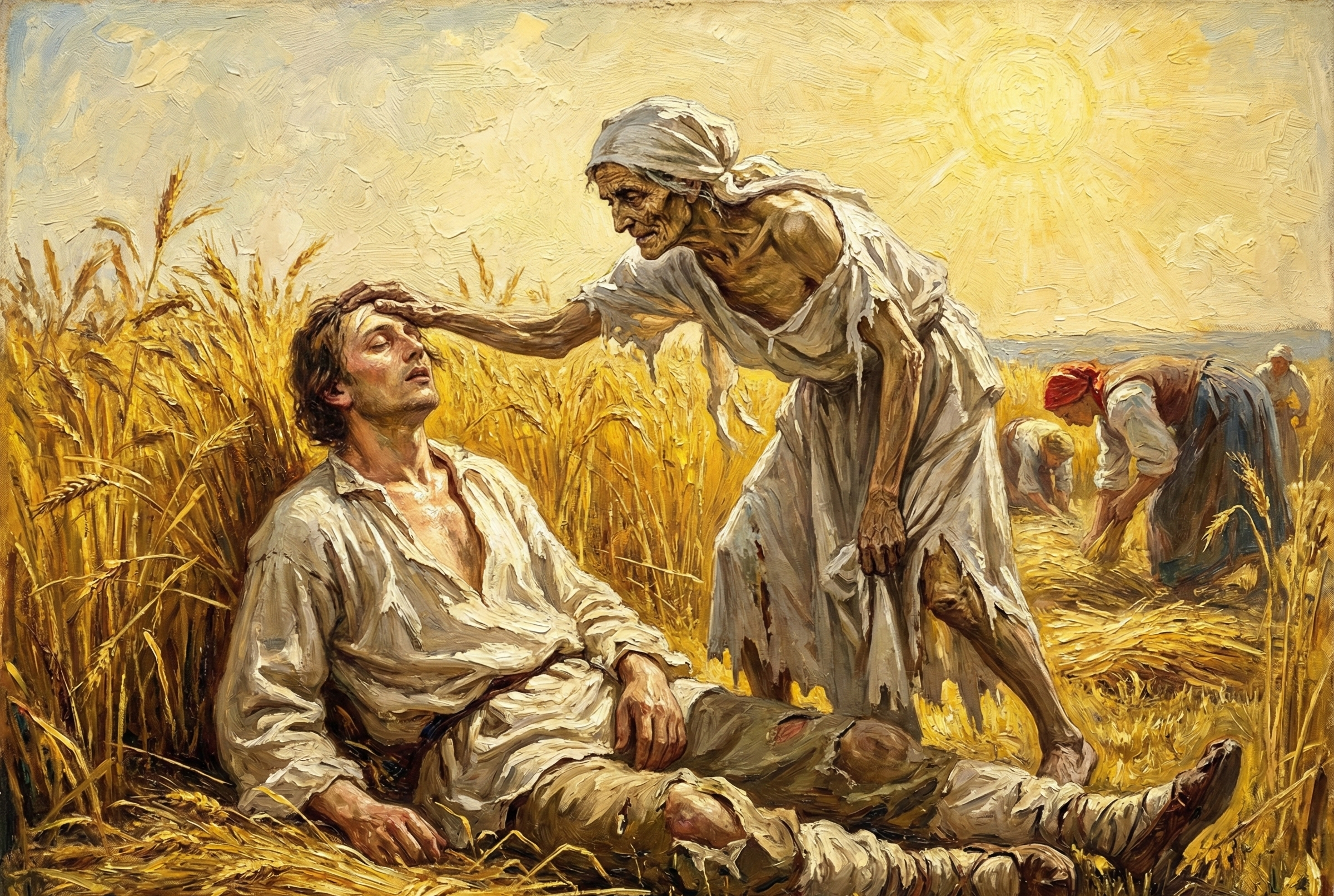
Here is the story of the Poludnica, reconstructed from the provided materials and woven into a fluid, dignified essay in English.
Poludnica: The Noon Wraith
In the dark and sprawling pantheon of Slavic demonology, the vast majority of malevolent spirits operate under the cold cover of night. But there is one terrifying exception. Poludnica, the Noon Wraith, is strictly diurnal. She does not hide in the shadows; she hunts when shadows vanish into nothingness. Emerging only at the absolute solar zenith, she is the deadly personification of the sun’s destructive power, bringing heatstroke, exhaustion, and madness to the golden fields of the harvest.
The Dead Hour of the South
The name Poludnica derives directly from the Slavic word południe, meaning both “noon” and “south”—the exact direction of the sun at midday. She is bound by a strict, almost mechanical temporal law. She appears at exactly 12:00 PM, not a single minute before or after.
Her arrival is unmistakable. It is heralded by a sudden, oppressive silence that falls over the cereal fields. The wind completely dies down, the cicadas abruptly cease their droning, and the air becomes thick and suffocatingly hard to breathe. This is the “dead hour,” a time when even the hardiest of animals seek the sanctuary of the shade. And in the midst of this sweltering stillness, the Lady Midday arrives.
The Dual Face of the Sun
When Poludnica manifests, she assumes one of two distinct forms, reflecting either her deceptive allure or her lethal intent.
To some, she appears as the White Maiden. In this form, she is breathtakingly beautiful—a tall, slender woman dressed in a flowing white linen gown that seems to radiate the sun’s glow. Her hair is pale gold, crowned with a woven wreath of wheat ears and bright blue cornflowers. Her skin is luminous and flawless. Weary men working in the fields are instantly lured to her, dropping their tools and forgetting the lethal heat as she smiles and beckons them closer.
But to those she has already marked for death, she reveals her true nature: the Withered Hag. In this nightmare form, her white dress is filthy, stained with sweat and the dirt of the fields. Her face is gaunt, the skin pulled tight over a skull-like visage, with sunken eyes that burn with a maddening fever. Tangled with straw and chaff, she grips a sharp sickle (sierp) in her bony hand—not as a tool for reaping grain, but as a gleaming weapon of execution.
The Riddle and the Strike
Poludnica is a methodical hunter. She prefers to walk the miedza—the narrow, unplowed boundary lines separating family plots. This liminal space, caught between cultivated land and the wild, is her absolute domain. She seeks out solitary reapers who have strayed from the rest of the crew.
Approaching her victim, she speaks in a strange voice that can be melodic or grating, but always unnaturally loud. She challenges the worker with complex riddles or impossible questions about agriculture. If the victim fails to answer, attempts to flee, or simply succumbs to the paralyzing dread of her presence, she strikes. The victim falls, clutching their chest in agony. While a modern doctor might later record the cause of death as severe heatstroke or cardiac arrest, the villagers always knew the truth: the victim had been struck down by the sickle of the Noon Wraith.
The Enforcer of the Sacred Rest
Beyond the horror of the myth, Poludnica served a profoundly practical function in ancient Slavic society: she was the absolute enforcer of the midday rest.
In the grueling agricultural calendar, the midday break was not a luxury; it was a matter of life and death. From roughly 11:00 AM to 2:00 PM, all labor in the fields was strictly forbidden. Workers retreated to the shade to eat, sleep, and wait for the worst of the heat to pass. The myth of Poludnica transformed this practical rule into a sacred law. You did not work at noon because the Lady Midday would kill you. This belief was so deeply effective that it persisted long after the old gods were replaced by Christianity, embedding the midday rest permanently into rural culture.
The Lure in the Tall Grain
Adults were not her only victims; Poludnica was also deeply feared as a kidnapper of children. Young ones playing near the edges of the fields were constantly warned never to wander into the tall wheat. Yet, the towering stalks and secret pathways were often too tempting for curious minds.
When a child wandered too far, Poludnica would spot them from the boundary lines. Mimicking the warm, familiar voice of the child’s mother, she would call out softly, luring the victim deeper and deeper into the sea of grain until the sky vanished and all directions looked the same. When desperate parents searched the fields at dusk, they might find their child sitting silently in the dirt, traumatized and unable to speak. Or, far more tragically, they might find nothing but trampled wheat, with the child lost forever to the suffocating heat of the Noon Wraith.