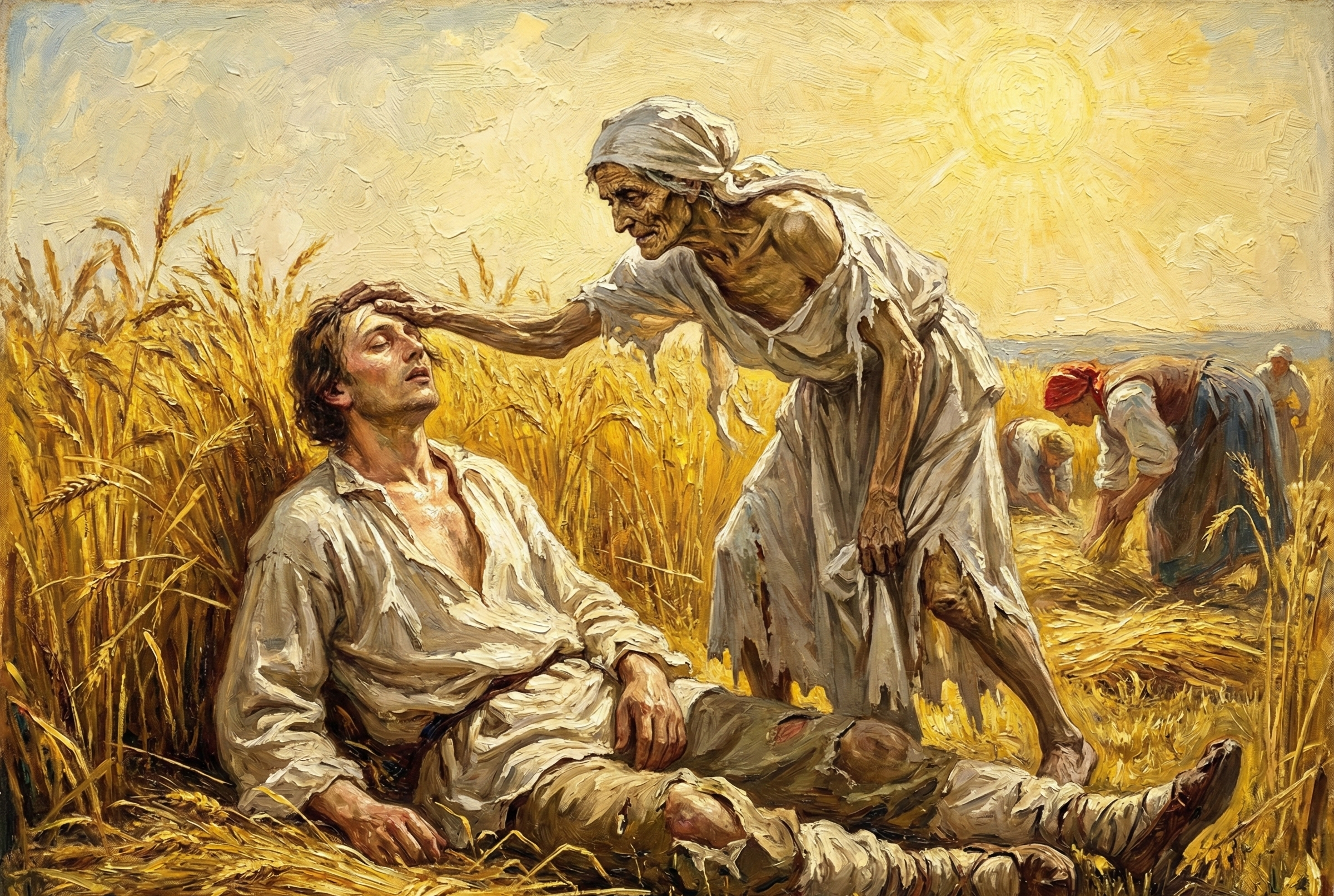
The Lady Midday, The Personification of Heatstroke, The Harvest Killer
[expand]
Poludnica is unique among Slavic demons in that she is strictly diurnal. While most malevolent spirits operate at night, under cover of darkness, poludnica appears only at the solar zenith—high noon, when the sun is at its absolute peak and shadows vanish into nothing.
She is the embodiment of the sun’s destructive power: heatstroke, exhaustion, madness. She haunts the open cereal fields—rye, wheat, barley—during the harvest season, when reapers work from dawn until dusk under a merciless sky.
[/expand]
The Etymology and Temporal Specificity
[expand]
The name Południca derives directly from the Slavic word for noon and south (południe). The south is the direction of the sun at midday. The word also carries connotations of stillness, heat, and danger—the “dead hour” when nothing moves, when even animals seek shade.
She appears at exactly 12:00 PM. Not a minute before, not a minute after. The arrival is marked by a sudden, oppressive silence. The wind stops. The cicadas cease their droning. The air becomes thick, hard to breathe. And then she is there.
[/expand]
The Dual Form: Beauty and Decay
[expand]
Poludnica manifests in two distinct forms, depending on her mood or the observer’s fate.
The White Maiden
In this form, she is breathtakingly beautiful—a tall, slender woman dressed in a flowing white linen dress that seems to glow in the sunlight. Her hair is long, pale gold, and she wears a wreath woven from wheat ears and cornflowers. Her skin is flawless, luminous. Her eyes are the color of a summer sky.
Men who see her in this form are lured. They stop working, transfixed. They approach, drawn by her beauty, forgetting the heat, forgetting the warnings. She smiles. She beckons. And then she asks a question.
The Withered Hag
In this form, she is a nightmare. Her dress is still white but filthy, stained with dirt and sweat. Her face is gaunt, the skin pulled tight over the skull, eyes sunken and burning with fever. Her hair is wild, tangled with straw and chaff. In her hand, she carries a sickle (sierp)—not the tool of a reaper, but a weapon, its blade gleaming in the sun.
This is the form she shows to those she has marked for death.
[/expand]
The Modus Operandi: The Riddle and the Strike
[expand]
Poludnica does not kill indiscriminately. She follows a specific pattern.
The Approach
She appears suddenly in the field, often at the boundary line (miedza)—the narrow strip of unplowed land that separates one family’s plot from another’s. This is a liminal space, neither fully cultivated nor fully wild, and it is her preferred territory.
She walks toward a worker—usually someone toiling alone, separated from the rest of the crew. The victim sees her and, depending on the form she has chosen, either feels drawn to her or filled with dread.
The Question
She speaks. Her voice is strange—sometimes melodic, sometimes harsh and grating, but always too loud, as if she is shouting even when she whispers.
She asks questions. The questions are always about textile work: the processing of flax, the weaving of linen, the preparation of thread. These are tasks traditionally performed by women, and the questions are complex, requiring detailed knowledge of every stage of the craft.
“How many steps are required to process flax from the harvested stalk to the finished thread?”
“What is the proper method for retting flax in dew versus in a stream?”
“Describe the pattern for weaving a checked linen cloth.”
The questions are not trivial. Even an experienced woman might struggle to answer them fully. And the victim must answer immediately, without hesitation. There is no time to think, no time to consult others.
The Strike
If the answer is wrong, or if the victim hesitates too long, Poludnica strikes.
She swings her sickle—not at the grain, but at the victim’s neck or spine. The blow is precise, surgical. It does not always kill outright, but it cripples. The victim collapses, their neck twisted at an unnatural angle, their spine severed. They die in the field, under the sun, and their body is found hours later when the crew returns from their midday rest.
Alternatively, she simply appears, and the sight of her is enough. The victim’s heart seizes. They fall, clutching their chest. Heatstroke, the doctors would say later. Cardiac arrest. But the villagers know better.
[/expand]
The Sphere of Influence: Enforcing the Sacred Rest
[expand]
The poludnica myth served a critical practical function: it enforced mandatory rest at noon.
In the Slavic agricultural calendar, the midday break was not optional. It was sacred. From roughly 11:00 AM to 2:00 PM, all labor ceased. Workers retreated to the shade, ate a light meal, napped, and waited for the worst of the heat to pass.
This was not laziness. It was survival. Working through the peak heat led to heatstroke—dizziness, confusion, collapse, death. The poludnica myth personified this danger and made it absolute. You did not work at noon because the Lady Midday would kill you.
The myth was so effective that it persisted long after Christianity replaced the old gods. Even today, in rural Slavic regions, the midday rest is still observed, though most people have forgotten why.
[/expand]
The Kidnapping of Children
[expand]
Poludnica also targets children, particularly those who wander into the tall grain fields.
The Lure
Children playing near the fields during harvest are warned repeatedly: “Do not go into the tall wheat. Poludnica will take you.”
But children are curious. The grain fields, with their towering stalks and secret pathways, are irresistible. They enter, playing hide-and-seek or chasing butterflies.
And Poludnica, walking along the boundary lines, sees them. She calls to them in a voice that sounds like their mother’s. “Come here, little one. Come to me.”
The child, hearing a familiar voice, follows. Deeper into the field, where the stalks are so tall that the sky is barely visible. Deeper, until they are lost, until they cannot find their way out.
By evening, when the child has not returned, the parents search. Sometimes they find the child, sitting in the middle of the field, staring at nothing, unable to speak. Sometimes they find only trampled wheat and no trace of the child at all.
[/expand]
The Boundary: The Miedza
[expand]
The miedza—the boundary line between fields—is poludnica’s primary haunt. These narrow strips of land were left unplowed to mark property lines, and they became wild zones, overgrown with weeds and wildflowers.
Sleeping on the miedza was considered suicidal. The boundary is a crack between worlds, and lying there, vulnerable, was an invitation to poludnica. She would find you, sit on your chest, and press down until you suffocated.
Farmers avoided the miedza at noon. They would not walk along it, would not rest there, would not even look at it if they could help it. It was hers.
[/expand]
Protection: Shade and Silence
[expand]
There were few effective protections against poludnica. She was too powerful, too tied to the sun itself.
But certain practices helped:
Retreat to shade at noon. If you were not in the field, you were not in her domain. The prohibition against working at midday was both practical and spiritual.
Do not answer strange questions. If a beautiful woman or a withered hag appeared and began asking about flax processing, the correct response was silence. Do not engage. Turn and walk away, slowly, without looking back.
Wear red. Red fabric—a ribbon, a sash—was believed to confuse or distract poludnica, though the reason for this is unclear. Perhaps the color reminded her of blood and satisfied her without violence.
[/expand]