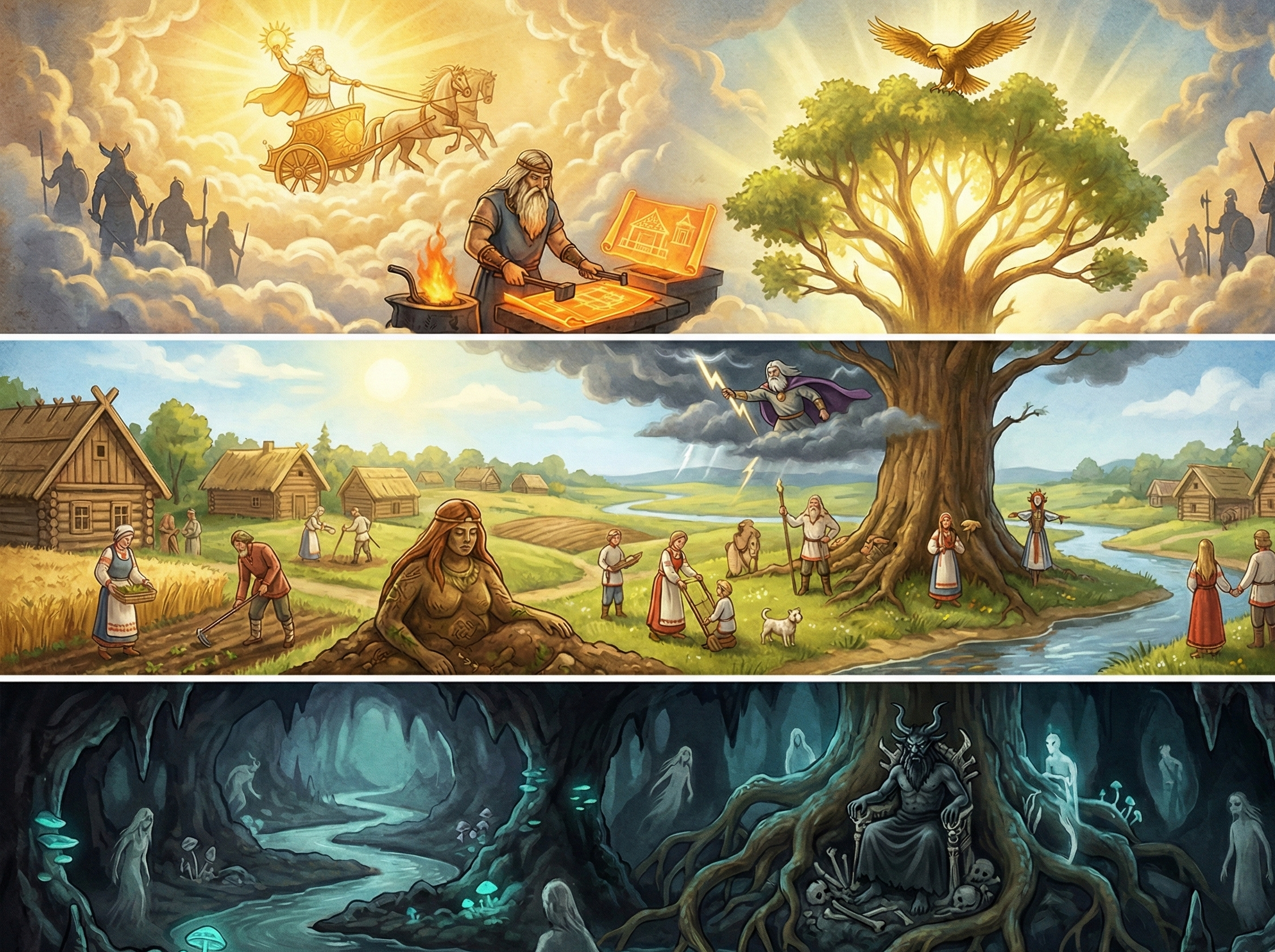
In the ancient Slavic worldview, the divine was not a distant, incomprehensible force, but a profound and multifaceted reflection of the cosmos itself. The gods were the physical and spiritual architects of reality, presiding over the forces that governed human survival, from the roaring skies to the deepest, silent roots of the earth. Their domains were fiercely divided, yet perfectly complementary, creating a pantheon that balanced order with chaos, and life with inevitable death.
The Solar Dynasty
At the absolute apex of this cosmic hierarchy sits Swaróg, the Celestial Smith. He is the ultimate, distant creator—the architect of cosmic law who forged the sun and granted the primal gift of fire to humanity. Having set the machinery of the universe into motion, Swaróg withdrew into the heavens, allowing his sons to govern the active, material world.
The most visible of his sons is Dadźbóg, the Sun. He is the daily, radiant presence of the divine, riding across the sky in a brilliant diamond chariot. Dadźbóg is the generous king and the source of warmth and golden light; he is young and vigorous at dawn, mighty at the solar zenith, and dies each dusk only to be miraculously reborn the following morning. Beside him in the earthly realm operates his brother, Swarożyc. He is the manifestation of terrestrial fire—the roaring flame in the sacred temple, the crackling hearth in the center of the home, and the living, breathing presence of divinity within the domestic sphere.
The Sovereign of Thunder
Perun stands as the supreme deity of the warrior class and the absolute enforcer of cosmic order. Envisioned as a formidable figure bearded in gold, wielding a heavy axe and riding the violent storms, Perun is justice made manifest. He is the righteous strike of the lightning bolt and the unyielding protector of oaths. In the ancient world, to swear by Perun and lie was to invite a deadly lightning strike from the heavens. His sacred oak groves served as the natural courtrooms of the tribes, and his priests were the ultimate keepers of the law.
The Sovereign of the Deep
In direct opposition to the rigid laws of the sky stands Weles, the Sovereign of the Deep. Weles rules over everything that Perun does not: the shadowy underworld, the horned cattle, and the hidden wealth that slumbers within the earth. He is the patron of poetry, which is born from trance, and the master of magic, which actively bends and subverts the rigid rules that Perun enforces. Weles is the ultimate shapeshifter, manifesting as a bear, a massive serpent, or an old man leaning on a staff. He is the god to whom merchants and magicians pray—the only deity who truly knows the secret, winding paths between the worlds of the living and the dead.
The Great Mother
Mokosh holds a place of immense, unrivaled veneration. As the only goddess explicitly named in the ancient Primary Chronicle’s pantheon, her importance cannot be overstated. She is Mat Syra Zemlya—Mother Moist Earth. She is the living, fertile soil and the silent weaver of human fate. To the ancient Slavs, every bubbling spring was her watchful eye, and every abundant harvest was her direct gift. Women prayed to Mokosh for safe childbirth, fertility, and protection. Her roots were so deeply embedded in the cultural psyche that even centuries after the aggressive Christianization of the Slavic lands, her powerful cult survived, barely disguised beneath the veneration of St. Paraskeva Friday.
The Seasonal Mystery
The relentless, cosmic drama of life and death, spring and winter, is embodied by Jaryło and Marzanna. Jaryło is the vigorous, untamed spirit of spring. Young, wild, and virile, he unlocks the frozen earth with his golden keys. He rides a pristine white horse, carrying the grim severed head of winter in one hand and a sheaf of fresh, golden grain in the other.
In stark contrast stands his sister and eternal counterpart, Marzanna. She is the embodiment of winter—cold, skeletal, and absolutely necessary, freezing the world so that the exhausted earth might finally rest. Their eternal, tragic cycle of marriage, death, and rebirth flawlessly mirrors the turning of the agricultural year and the fleeting span of human life.