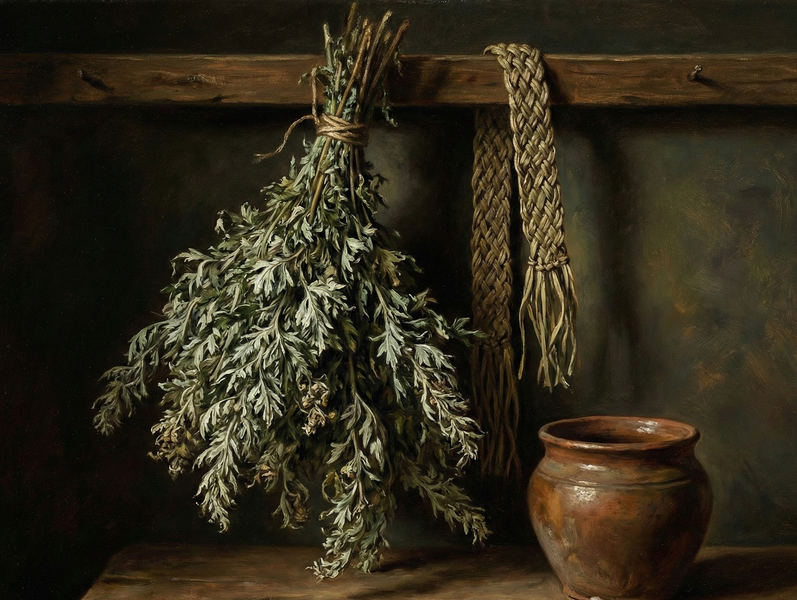
- The Conversation with Plants
The Slavic herbalist did not harvest plants. That verb implies taking, extraction, dominance—a relationship foreign to the ancient worldview. The herbalist conversed with plants. Before touching leaf or root, the znakharka (female healer) or znakhar (male healer) spoke. Not metaphorically. Not symbolically. Literally spoke—aloud, with intention, with humility.
“Babciu-zioło, potrzebuję twojej pomocy. Dziecko gorączkuje. Matka płacze. Czy zechcesz się podzielić swoją mocą?”
(“Grandmother-herb, I need your help. A child burns with fever. The mother weeps. Will you share your strength?”)
The plant did not answer in words. It answered in signs. A sudden breeze bending the stalk toward the gatherer meant yes. A bird landing on the branch—yes. A feeling of warmth in the chest—yes. But if the wind turned away, if a cloud obscured the sun, if unease gripped the heart—the herbalist moved on. That plant, on that day, said no. Forcing the matter would yield medicine that failed or, worse, harmed.
This was not superstition. This was ecology translated into theology. The Slavs understood what modern science confirms slowly, reluctantly: plants are chemical factories of staggering complexity. Their medicinal compounds vary by soil, season, weather, time of day, and stress levels. A feverfew gathered at noon in drought produces different alkaloids than one gathered at dawn after rain. The “conversation” was the herbalist’s method of reading these invisible variables—intuition honed by generations of observation, dressed in the language of respect.
- The Threefold Knowledge
To practice herbalism was to master three interlocking bodies of knowledge, each insufficient without the others.
The Botanical: What Heals What
This was the foundation—the vast mental library of correspondences between plant and ailment.
Willow bark (wierzba) for fever. The gnawing heat that made children delirious, that turned strong men into shivering wrecks—willow cooled it. Strip the inner bark in spring when sap runs strong. Boil it into bitter tea. Drink it scalding hot, three times daily. The fever breaks within two days, or the illness is beyond willow’s reach.
Yarrow (krwawnik) for wounds. The ragged gash from axe slip, the puncture from thorn, the sword cut that wouldn’t stop bleeding—yarrow staunched it. Crush fresh leaves into paste. Pack directly into wound. Bind tightly. The bleeding slows, then stops. Infection rarely follows if yarrow is applied immediately.
Mint (mięta) for stomach pain. The cramping that doubled a person over, the nausea that prevented eating, the bloating that made breathing difficult—mint soothed it. Fresh leaves chewed slowly, or dried leaves steeped in hot water. Drink after meals. The pain eases.
Garlic (czosnek) for infection. The rot that turned wounds black, the lung sickness that drowned the afflicted in their own fluids, the wasting diseases that consumed flesh—garlic fought them. Eaten raw daily, or crushed into poultices for external infections. Its sharp oils killed what the body could not.
St. John’s Wort (dziurawiec) for melancholy. The darkness that descended without cause, the weight that made rising from bed impossible, the numbness that extinguished joy—St. John’s Wort lifted it. Gathered on midsummer eve, when potency peaked. Dried and infused into oil, taken daily in small doses. Light returned gradually, like dawn.
But knowing what was only the beginning.
The Temporal: When to Gather
The same plant harvested at different times was not the same medicine. Timing determined potency, safety, effectiveness.
Moon phases mattered. Roots gathered during waning moon (when earth’s energy pulled downward) were stronger than those gathered during waxing moon (when energy pushed upward into leaves and flowers). Flowers gathered at full moon contained maximum essential oils. Seeds collected at new moon stored longest without spoiling.
Season mattered. Spring roots, before the plant expended energy on growth. Summer flowers, at peak bloom. Autumn seeds, fully ripened. Winter bark, when sap retreated and concentration intensified. Gathering out of season yielded weak medicine or none at all.
Time of day mattered. Dawn, before sun evaporated volatile oils. Dusk, after heat peaked but before dew diluted compounds. Noon for solar plants (St. John’s Wort, chamomile). Midnight for lunar plants (mugwort, moonflower). The herbalist rose at strange hours, worked by candlelight or starlight, because the clock dictated chemistry.
Weather mattered. Drought-stressed plants produced defensive compounds in higher concentration—more potent but potentially toxic. Rain-soaked plants diluted their medicine—safer but weaker. The herbalist learned to read the plant’s biography written in its tissues: this yarrow grew in poor soil and will be strong, that mint thrived in rich loam and will be gentle.
The Spiritual: How to Approach
The plant was not object but person. Approaching wrongly meant refusal or retaliation.
Offerings preceded taking. A pinch of bread crumbled at the plant’s roots. A splash of water or kvass. A copper coin buried nearby. Sometimes simply a spoken promise: “I will use this wisely. I will not waste it. I will help, not harm.” The offering acknowledged debt—you are taking life (the plant’s leaves, roots, or flowers), so you must give life (food, drink, metal that endures).
Quantity limits mattered. Never take all. Leave at least one-third of the plant intact—more if the species was rare. This was practical (ensuring future harvests) and spiritual (greed offended the plant’s spirit, turning medicine into poison). Herbalists who stripped locations bare found those plants ceased growing there, or grew twisted and bitter.
Tools mattered. Iron blades for some plants (those aligned with Perun—aggressive, purging herbs). Wooden or bone tools for others (those aligned with Mokosh—gentle, nourishing herbs). Bare hands for the most sacred (plants that required direct skin contact, blood-to-sap connection). Using wrong tool could “anger” the plant—metaphor for disrupting delicate chemistry.
State of mind mattered. The gatherer must be calm, focused, respectful. Harvest in anger, and the medicine fails. Harvest in grief, and it absorbs that grief, passing it to the patient. Harvest in love and gratitude, and it heals beyond its chemical properties. Modern medicine dismisses this as placebo effect. Slavic herbalists understood it as energetic transfer—the gatherer’s state imprints on the medicine.
III. The Preparation: From Plant to Pharmacy
Raw plants rarely worked. Preparation transformed them from inert matter into active medicine—but wrong preparation destroyed potency or created poison.
Drying
Most herbs required drying to concentrate compounds and enable storage. But not all drying was equal.
Sun-drying: For robust plants (roots, bark, thick leaves). Spread on clean cloth in direct sunlight. Turn daily. Ready when brittle. Sun intensified solar properties—good for warming, energizing herbs.
Shade-drying: For delicate plants (flowers, thin leaves, aromatic herbs). Hang in bundles in dark, ventilated space. Slow process preserving volatile oils. Ready when papery. Shade protected lunar properties—good for cooling, calming herbs.
Smoke-drying: For preservation and purification. Hang above hearth fire (but not in direct flame). Smoke kills mold, repels insects, adds antiseptic properties. Ready when color darkens slightly. Used for sacred herbs and those storing long-term.
Infusion (Tea)
Simplest preparation. Pour boiling water over dried herbs. Steep 5-15 minutes depending on plant. Strain. Drink.
But details mattered. Water quality (spring water superior to stagnant pond). Vessel material (clay or wood, never metal which reacted with compounds). Covering during steeping (trapped volatile oils). Temperature (some herbs destroyed by boiling, requiring warm-not-hot water).
Decoction (Strong Tea)
For tough materials—roots, bark, hard seeds. Simmer in water 20-60 minutes. Longer extraction pulled deeper compounds. Stronger medicine for chronic conditions or stubborn illnesses.
Tincture (Alcohol Extraction)
For long-term storage and maximum potency. Pack jar with fresh or dried herbs. Cover completely with alcohol (vodka, moonshine, strong mead). Seal. Store in dark place 2-6 weeks, shaking daily. Strain. Bottle.
Alcohol extracted compounds water couldn’t, preserved indefinitely, and delivered medicine rapidly. But alcohol itself was medicine or poison depending on dose and patient.
Poultice (External Application)
For wounds, swelling, pain. Crush fresh herbs into paste (adding water, oil, or fat if needed). Apply directly to affected area. Cover with cloth. Leave 15 minutes to several hours. Reapply as needed.
Fresh poultices were strongest but spoiled quickly. Dried herbs mixed with liquid made acceptable substitutes.
Salve (Ointment)
For skin conditions, burns, chronic pain. Infuse herbs in oil or fat (heat gently, do not boil, strain). Add beeswax to solidify. Pour into containers. Cool.
Long-lasting, portable, protective. Salves created barrier while delivering medicine slowly over time.
- The Specific Remedies: Problems and Plants
The herbalist’s knowledge was vast, specific, and empirically tested across generations.
Fever (Gorączka)
Willow bark (wierzba): Boiled into tea. Contains salicin (aspirin’s precursor). Reduces fever, relieves pain.
Elderflower (dziki bez): Infusion drunk hot, induces sweating. Breaks fever by purging heat through skin.
Linden flower (lipa): Gentle fever reducer, especially for children. Calming, hydrating.
Wounds (Rany)
Yarrow (krwawnik): Stops bleeding, prevents infection. Fresh poultice or dried powder.
Plantain (babka): Draws out infection, promotes healing. Crush fresh leaves, apply directly.
Comfrey (żywokost): Heals bone and tissue rapidly. Poultice for fractures, sprains, deep cuts. (Modern warning: internal use toxic to liver—Slavs used externally only.)
Digestive Problems (Problemy Żołądkowe)
Mint (mięta): Cramps, nausea, gas. Tea after meals.
Chamomile (rumianek): Inflammation, ulcers, stress-related stomach pain. Gentle, safe for children.
Fennel (koper włoski): Bloating, colic (especially in infants). Seeds chewed or steeped.
Respiratory Illness (Choroby Oddechowe)
Mullein (dziewanna): Coughs, congestion, asthma. Leaves smoked or infused into tea.
Thyme (tymianek): Lung infections, bronchitis. Strong antimicrobial. Tea or steam inhalation.
Pine needles (sosna): Chest congestion, general weakness. Infusion rich in vitamin C.
Women’s Health (Zdrowie Kobiet)
Raspberry leaf (malina): Uterine tonic, eases childbirth, regulates menstruation. Tea drunk throughout pregnancy.
Lady’s mantle (przywrotnik): Heavy bleeding, menstrual pain. Astringent, hormone-balancing.
Yarrow (krwawnik): Regulates cycle, reduces excessive bleeding. Tea or tincture.
Mental/Emotional (Umysł i Emocje)
St. John’s Wort (dziurawiec): Depression, anxiety, trauma. Long-term use (weeks to months) required.
Valerian (kozłek): Insomnia, nervous tension, panic. Root tea or tincture before bed.
Mugwort (bylica): Nightmares, spiritual unease, prophetic dreams. Smoked or placed under pillow.
Infection/Immunity (Infekcja/Odporność)
Garlic (czosnek): Bacterial/viral/fungal infections. Eaten raw or applied topically.
Echinacea (jeżówka): Immune stimulant. Prevents/shortens illness. Root tincture.
Nettle (pokrzywa): General tonic, blood builder, allergy relief. Young spring leaves cooked as food or dried for tea.
- The Dangers: When Plants Harm
Not all plants healed. Some killed. The line between medicine and poison was dose, preparation, and knowledge.
Belladonna (wilcza jagoda): Dilated pupils (used by women for beauty), hallucinations at higher doses, death at slightly higher doses still. Useful in experienced hands for pain and muscle spasms. Deadly in ignorance.
Hemlock (szczwół): Paralysis, respiratory failure, death. No safe medicinal use. Gatherers learned to recognize it absolutely—confusing it with safe plants like wild carrot or parsley was fatal.
Foxglove (naparstnica): Heart medicine at precise doses (strengthens failing heart). Heart attack at slightly higher doses. Modern medicine refined it into digitalis. Ancient herbalists used it with extreme caution, if at all.
Mistletoe (jemioła): Sacred to druids, toxic to Slavs who used it cautiously for epilepsy and high blood pressure. Berries especially dangerous.
The herbalist learned these not from books (which didn’t exist for most) but from apprenticeship. The teacher showed: this is yarrow, this is hemlock, never confuse them. The student repeated identification hundreds of times until recognition became instant, automatic, certain. Lives depended on it.
- The Gathering Rituals: Protocol and Prayer
The act of gathering was ceremony.
The Approach
Walk slowly. Announce presence. “Leshy, I enter your forest. I come in peace. I take only what I need.”
The Selection
Examine multiple specimens. Choose the healthiest unless treating severe illness (then choose the strongest-smelling, most potent). Never take rare plants unless absolutely necessary.
The Offering
Before cutting, place offering at base: bread, salt, water, coin. Sometimes blood (finger-prick) for most sacred plants.
The Prayer
“Matko-ziemio, dajesz nam lekarstwo. Przyjmij nasze podziękowanie. Użyjemy tego mądrze.”
(“Mother-earth, you give us medicine. Accept our gratitude. We will use this wisely.”)
The Cutting
Swift, clean cut. No hesitation, no sawing. A respectful kill if taking whole plant; a careful pruning if taking part.
The Thanks
After gathering, bow to the plant. Touch forehead to ground if taking root. “Dziękuję. Twoja ofiara nie będzie zmarnowana.” (“Thank you. Your sacrifice will not be wasted.”)
The Departure
Walk backward three steps before turning away (showing respect, not turning one’s back immediately). Do not speak of the harvest until home (silence protects the medicine).
VII. The Christian Overlay: Saints and Herbs
The Church could not eliminate herbalism—people needed medicine. So it baptized the practice.
Plants previously sacred to Mokosh became St. Mary’s herbs. Gathering prayers invoked saints instead of nature spirits. The structure remained identical; only names changed.
Mother of God’s bedstraw (lady’s bedstraw): Childbirth aid, previously Mokosh’s plant.
St. John’s Wort: Midsummer gathering continued, now tied to St. John’s feast day rather than solstice.
Blessed thistle: Protection plant, blessed by priests, same function as pre-Christian warding herbs.
The babki (wise women) adapted. They crossed themselves, invoked saints, attended church. But the offerings at the plant’s roots continued. The moon-phase timing continued. The careful approach continued. Christianity provided cover; the old knowledge persisted beneath.
VIII. The Modern Legacy: What Survives
Slavic herbalism never died because it worked. Modern pharmacology validates it repeatedly.
Willow bark → Aspirin
Foxglove → Digitalis
Poppy → Morphine
Garlic → Allicin (antibiotic)
The chemical compounds ancient herbalists accessed through intuition and tradition, modern labs isolate and synthesize. The difference: the lab extracts single molecules; the herbalist used whole plants with complex interactions—often safer, sometimes more effective, always more holistic.
Eastern European folk medicine retained more herbal knowledge than Western Europe, where industrialization and pharmaceutical companies replaced plants with pills earlier. Rural Slavic communities used herbs into the 21st century—not from backwardness but from effectiveness and necessity.
- The Principle: Partnership, Not Domination
The essence of Slavic herbalism was relationship.
The plant was not resource but partner. The illness was not enemy but message. The body was not machine but ecosystem. Healing happened when all parties cooperated—patient’s will, healer’s knowledge, plant’s medicine, spirit’s permission.
This was not primitive superstition but sophisticated ecology. The “spiritual” language encoded practical wisdom: respect prevents overharvesting; seasonal gathering ensures potency; offerings maintain humble relationship with nature.
Modern medicine’s power lies in emergency intervention—surgery, antibiotics, vaccines. But for chronic conditions, preventive care, and holistic wellness, the ancient approach offers something lost: understanding illness within context, treating person not just symptoms, working with nature rather than against it.
The plant speaks.
The healer listens.
The sick body receives.
And the forest continues its ancient work, waiting patiently for the next conversation.