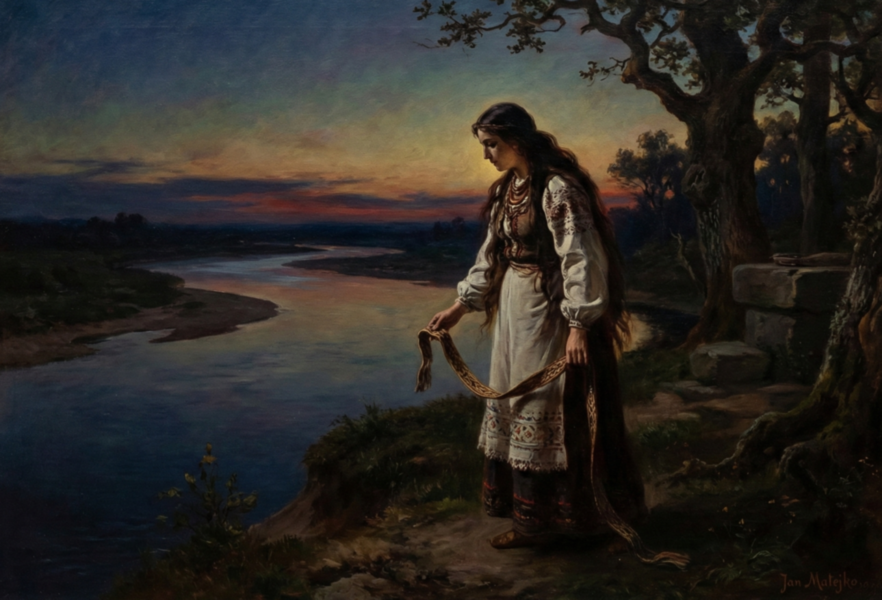
- The Living Water
Water was not H₂O to the ancient Slavs. Water was Mokosh’s blood, the earth’s tears, the liquid boundary between worlds. It fell from sky (Perun’s gift), collected in earth (Mokosh’s womb), and flowed to the sea (Weles’s realm). Water participated in all three cosmic levels simultaneously—it was the universal connector, the medium of transformation, the substance that dissolved boundaries.
Still water and moving water were different entities. A stagnant pond and a rushing river might both be water, but they had different spirits, different properties, different medicines. Springs were different still—water emerging directly from earth without having traveled across surface. This made springs particularly sacred, particularly powerful, particularly dangerous.
The spring was wound in Mokosh’s body—place where her blood seeped through skin to nourish the world above. Every spring was potentially holy. Every spring was potentially healing. But accessing that holiness and healing required knowledge, respect, and correct approach.
To drink from a spring carelessly was to risk offense. To drink after proper offering and prayer was to receive blessing. The difference wasn’t in the water’s chemical composition but in the relationship between human and source.
- The Types of Springs: Each With Its Medicine
Not all springs were equal. Different origins, different minerals, different spirits.
The Clear Spring (Czyste Źródło)
The ideal healing spring was absolutely clear—you could see the bottom no matter how deep, could count pebbles at five feet down, could watch sand boil where water emerged from earth. Clarity indicated purity, both physical and spiritual.
Clear springs treated eye problems. The logic was sympathetic—clear water cleansed cloudy vision. But it worked. The cold water soothed inflammation, the flow washed out irritants, and the minerals (if present in right balance) promoted healing.
Clear springs were also sites for oath-taking and truth-telling. The transparency symbolized honesty. To lie at a clear spring was to risk the spring going dry or becoming clouded—punishment affecting the entire community.
The Iron Spring (Żelazne Źródło)
Springs with high iron content were recognized by the red-orange staining around the outlet and the metallic taste. These springs treated “weakness of the blood”—what we now call anemia.
The water from iron springs, drunk regularly, did restore strength to the pale and exhausted. Modern medicine confirms: the dissolved iron is bioavailable, the body absorbs it, and symptoms improve. The ancient observation was accurate.
Iron springs were associated with Perun—iron was his metal, red was his color (lightning’s flash, blood of sacrifice). Warriors before battle would drink from iron springs to absorb the god’s strength.
The Sulfur Spring (Siarkowe Źródło)
Sulfur springs announced themselves by smell—the distinctive rotten egg odor of hydrogen sulfide. These springs were hottest controversy in folk medicine.
On one hand, sulfur water treated skin conditions brilliantly. Eczema, psoriasis, fungal infections, chronic wounds—all responded to sulfur spring baths. The sulfur’s antimicrobial properties (now understood scientifically) killed surface pathogens and promoted healing.
On the other hand, sulfur was associated with the underworld, with demons, with corruption. The smell was death’s smell. Some communities avoided sulfur springs entirely, believing them cursed or poisoned.
The resolution: sulfur springs were liminal, dangerous, powerful. They required extra precautions—more offerings, more prayers, more careful approach. The medicine was strong precisely because the danger was real.
The Salt Spring (Słone Źródło)
Salt springs were rare treasures—places where brine emerged from earth without requiring solar evaporation of seawater. Communities built around salt springs became wealthy and spiritually significant simultaneously.
Salt water was drunk (carefully, in small amounts) as purgative—it cleared the bowels forcefully, eliminating what the body needed to expel. Salt baths eased joint pain and muscle aches. Salt vapor (from boiling the spring water) was inhaled to clear respiratory congestion.
Salt springs were never private property. They belonged to the community collectively, managed by elders or priests. To monopolize a salt spring was sacrilege and invitation to disaster.
The Cold Spring (Zimne Źródło)
Springs that remained ice-cold even in summer had special properties. The water emerged from deep in the earth where summer sun couldn’t reach—this made it “earth’s true temperature,” unchanged by surface fluctuations.
Cold springs treated fevers. The patient was stripped and doused with the frigid water, sometimes repeatedly. This was shock therapy—the sudden cold caused violent shivering, increased metabolism, and often broke the fever.
Cold springs also preserved food. Meat, dairy, vegetables placed in the spring’s outflow stayed fresh much longer. This was practical physics (cold inhibits bacterial growth) understood as spiritual gift (the spring shared its preservation power).
The Warm Spring (Ciepłe Źródło)
Naturally warm springs—emerging at temperatures above ambient—were marvels. Most Slavic lands lacked volcanic activity, making warm springs extremely rare and correspondingly sacred.
Warm springs treated everything cold-related: arthritis, rheumatism, poor circulation, chronic pain. The warmth itself was healing, and the dissolved minerals (often higher in warm springs) provided additional benefits.
Warm springs were associated with fire deities (Swarożyc) despite being water. The paradox of fire and water combined made them powerful transformative sites—places where opposites united, where healing occurred through reconciliation of contradictions.
III. The Spring Spirits: Who Dwells in the Water
Every spring had a spirit—a localized consciousness that inhabited and guarded that particular source.
The Water Maiden (Wodnica)
Some springs, especially those with pools or wide outflows, were home to wodnice—water maidens, young female spirits who dwelled in the depths. They were generally benevolent but particular about respect.
Offerings to wodnice included:
- Flowers (thrown into the water)
- Ribbons (tied to trees overhanging the spring)
- Bread (dissolved in the water)
- Songs (sung at the spring’s edge)
The wodnica’s mood affected the spring’s flow and quality. An offended wodnica might cause the spring to run foul, dry up temporarily, or even cause drowning of those who approached disrespectfully.
The Old One (Dziad Wodny)
Other springs, particularly those emerging from rocks or caves, were guarded by male spirits—old men of the water, often depicted with long beards made of moss or algae.
The old one was stricter than the wodnica, less forgiving of errors. His springs required more formal approaches:
- Never approaching empty-handed (always bring offering)
- Never speaking loudly or irreverently near the spring
- Never urinating upstream or near the source
- Never taking more water than needed
Violating these rules meant the spring’s power would be withdrawn from you personally. Others could still benefit, but you would find no healing there.
The Snake Guardian (Wąż Strażnik)
Many sacred springs had resident snakes—not coincidentally but as recognized guardians. The snake lived at the spring, drank its water, protected it from pollution and desecration.
These guardian snakes were never killed. They were offered milk and eggs. Children were taught to recognize and respect them. The snake’s presence authenticated the spring’s power—if the snake left, the spring’s medicine weakened.
- The Ritual Approach: How to Drink From Sacred Springs
Accessing a spring’s healing power required protocol.
The Arrival
Approach slowly, quietly, observantly. Watch for signs of the spring’s mood—is the water flowing freely or sluggishly? Are birds or animals present? Does the area feel welcoming or forbidding?
Announce yourself: “I come in respect. I come in need. I ask permission to drink.”
The Offering
Place your offering at the spring’s edge or in the water:
- Coins (silver preferred, but any metal acceptable)
- Bread (small piece, fresh if possible)
- Flowers (seasonal, gathered locally)
- Honey (mixed with water if very thick)
Speak your intention: “I give this in gratitude. I take only what I need. I will remember this gift.”
The Drinking
Cup your hands and fill them with water. Do not use a vessel on first drink—the water must touch your skin directly, unmediated by object.
Drink slowly, three sips minimum:
- First sip for body (physical healing)
- Second sip for soul (spiritual cleansing)
- Third sip for the bond (relationship with the spring)
If taking water away in a vessel, explain why: “I take this for [sick family member], who cannot come here. I ask blessing for this water to carry your power.”
The Departure
Thank the spring explicitly: “Thank you for this gift. May you flow forever. May I return in health.”
Back away rather than turning your back immediately—showing continued respect until you’re clear of the spring’s immediate area.
The Taboos
Never do these things at sacred springs:
- Wash dirty clothes (use downstream water if necessary)
- Bathe naked (unless specifically instructed in a healing vision)
- Defecate or urinate nearby
- Bring iron tools directly to the water (leave them at distance)
- Argue or fight (springs respond badly to violence)
- Take water for profit without permission (commercial use requires special arrangements)
- The Healing Baths: Immersion Medicine
Some springs formed pools large enough for bathing—these were particularly powerful healing sites.
The Full Immersion
For serious illness, partial measures weren’t enough. The patient needed complete immersion in the spring’s water.
The procedure:
- Fast for a day before bathing (empty body receives better)
- Approach the pool at dawn or dusk (liminal times)
- Make offering to the spring spirit
- Enter the water slowly, immersing gradually
- Remain submerged to the neck for as long as tolerable (often very cold)
- Speak prayer or healing intention while in water
- Exit and wrap in clean cloth
- Rest quietly, allowing the water’s work to continue
Repeat daily for three, seven, or nine days (sacred numbers).
The Selective Bath
For localized problems (injured limb, skin condition on one area, joint pain), partial immersion sufficed:
- Sit at the pool’s edge
- Immerse the affected area
- Hold it in the water while speaking directly to the pain or condition
- “I give you to the water. The water accepts you. You are leaving me.”
This externalized the illness, imagining it flowing out into the water and being carried away downstream to dissolution.
The Medicinal Mud
Springs often had clay or mud deposits at their edges—this mud, soaked in the spring’s water and minerals, became powerful medicine.
The mud was applied as poultice:
- Spread directly on wounds, rashes, or aching joints
- Wrap with cloth to hold in place
- Leave for hours or overnight
- Rinse with spring water
The mud drew out infection, reduced inflammation, and left minerals in the skin that continued working after removal.
- The Spring Communities: Guardians and Healers
Major healing springs attracted communities who lived nearby and managed access.
The Spring Keeper (Strażnik Źródła)
This was usually an elder, often a woman, who had devoted herself to the spring’s service. She lived close by, maintained the area, guided visitors in proper protocols, and mediated between human needs and spirit requirements.
The spring keeper wasn’t paid directly but received gifts from those who came seeking healing. She used these resources to maintain the site and support herself.
Her knowledge was extensive:
- Which offerings the spring preferred
- What time of day the water was strongest
- Which conditions the spring healed best
- What signs indicated the spring spirit’s displeasure
The Resident Healer (Lecznik)
Some springs had resident healers—specialists in using the spring’s water combined with herbal medicine, ritual, and practical care. These weren’t priests but practitioners, combining empirical knowledge with spiritual understanding.
The healer would:
- Diagnose the condition
- Prescribe the treatment (how much water, how often, what additional measures)
- Perform necessary rituals
- Monitor progress
- Adjust treatment as needed
Payment was on sliding scale—the wealthy gave generously, the poor gave what they could, the destitute received care freely (the spring’s medicine wasn’t for sale, though the healer’s time deserved compensation).
The Pilgrim Community
Popular healing springs developed semi-permanent communities of pilgrims—people who stayed for extended treatment, sometimes weeks or months.
These communities had their own culture:
- Shared stories of successful healings (building faith and hope)
- Collective rituals (group prayers at the spring)
- Mutual support (helping the sickest, sharing resources)
- Transmission of knowledge (teaching proper protocols to newcomers)
The atmosphere was both hospital and temple—serious illness being addressed, but in context of spiritual practice and community solidarity.
VII. The Dream Springs: Seeking Visions
Some springs gave visions as well as healing—or rather, visions were part of the healing.
The Incubation Ritual
This was borrowed from or parallel to Greek practices but distinctly Slavic in execution:
The seeker would:
- Fast for three days
- Sleep beside the spring for three nights
- Drink the spring water before sleeping
- Record dreams upon waking
The dreams often contained diagnostic information (what was wrong), treatment instructions (what to do), or prophetic material (what would happen).
The spring transmitted knowledge directly to the subconscious, bypassing rational mind’s filters and objections.
The Scrying Pool
Still, clear spring pools could be used for scrying—looking into the water to see visions of distant events, future possibilities, or hidden knowledge.
The seer would:
- Approach at twilight or just before dawn
- Make offering and state intention
- Gaze into the water’s surface without forcing
- Allow images to emerge naturally
- Interpret what appeared (literal scenes or symbolic messages)
Not everyone could scry successfully—it required particular gift combined with training. But the spring amplified whatever latent ability existed.
VIII. The Water Taking: Carrying Spring Water Home
The spring’s power could be transported, though it diminished with distance and time.
The Sacred Container
Water taken from healing springs needed proper vessel:
- Clean (freshly washed, never used for profane purposes)
- Blessed (offered to the spring before filling)
- Sealed (to prevent contamination or evaporation)
- Carried carefully (no sloshing, no spilling)
Glass or ceramic were preferred over metal (except silver, which actually preserved water quality).
The Usage Instructions
Spring water taken home had specific applications:
- Drink one cup daily until gone (don’t hoard)
- Use for preparing healing herbs (amplifies their power)
- Wash wounds or rashes (external medicine)
- Add to bath water (diluted healing)
- Sprinkle around home for spiritual cleansing
The water’s power lasted days to weeks depending on storage conditions and the spring’s intrinsic strength.
The Renewal Requirement
You couldn’t just take once and never return. Relationship with the spring required maintenance:
- Return with thanks when healing occurred
- Bring offering of gratitude (often more generous than the original request offering)
- Share knowledge of the spring with others who need it
- Maintain respect even at distance (speak well of the spring, honor water generally)
- The Christian Overlay: Holy Wells
Christianity couldn’t eliminate spring worship, so it absorbed it.
The Saint Springs
Sacred springs became “holy wells” associated with Christian saints:
- The spring where St. Adalbert appeared
- The well blessed by St. Stanislaus
- The pool where the Virgin Mary’s icon was found
The veneration continued, the offerings continued, the healing continued—only the vocabulary changed.
The Blessing Ceremonies
Priests would “bless” springs, claiming to Christianize them. But the blessing ritual itself resembled pagan practice:
- Procession to the spring
- Prayers spoken at the water
- Cross placed in or near the water
- Holy water (from the spring) distributed to participants
The spring’s power was acknowledged, merely reattributed to Christian deity rather than Mokosh or local spirit.
The Persistent Paganism
Underneath Christian forms, pagan practices persisted:
- Offerings of ribbons, flowers, and coins continued (called “decorations” or “donations”)
- Bathing rituals remained unchanged
- The same diseases were treated in the same ways
- The spring spirits were remembered, even if not mentioned publicly
- The Modern Springs: What Survives
Many healing springs still exist, still attract pilgrims, still provide healing.
The Spa Tradition
Modern European spa culture derives directly from sacred spring tradition. The mineral baths, the healing waters, the health resorts—all built on ancient recognition that certain springs heal.
The theology has been medicalized—we speak of mineral content, temperature, and chemical composition rather than spirits and offerings. But the basic recognition remains: this water, from this particular place, has power to heal.
The Protected Sites
Some ancient sacred springs are now protected as natural monuments or cultural heritage sites. The protection preserves them physically, though the spiritual context is usually absent from official descriptions.
Visitors still throw coins in, still tie ribbons to nearby trees, still drink the water with reverence they might not fully understand. The gestures persist even when their meaning has been forgotten.
The Rediscovery
Modern pagans and spiritual seekers are rediscovering sacred springs, attempting to reconstruct ancient protocols from folklore fragments and archaeological evidence. The springs themselves seem to respond—people report healing, visions, and spiritual experiences that echo older testimonies.
The Teaching
Springs taught fundamental lesson: healing comes from the earth. Not from human invention, not from imported medicine, not from expensive treatment—from the planet itself, offering freely what humans need.
But freely doesn’t mean carelessly. The spring gives, but you must approach correctly—with respect, with offering, with relationship in mind.
This is the pattern for all human interaction with nature: take what you need, give something back, maintain relationship across time.
The spring still flows.
The water still heals.
The offering is still required.
And Mokosh’s blood still seeps through the earth’s skin, waiting for the cupped hands of those who remember how to ask.